

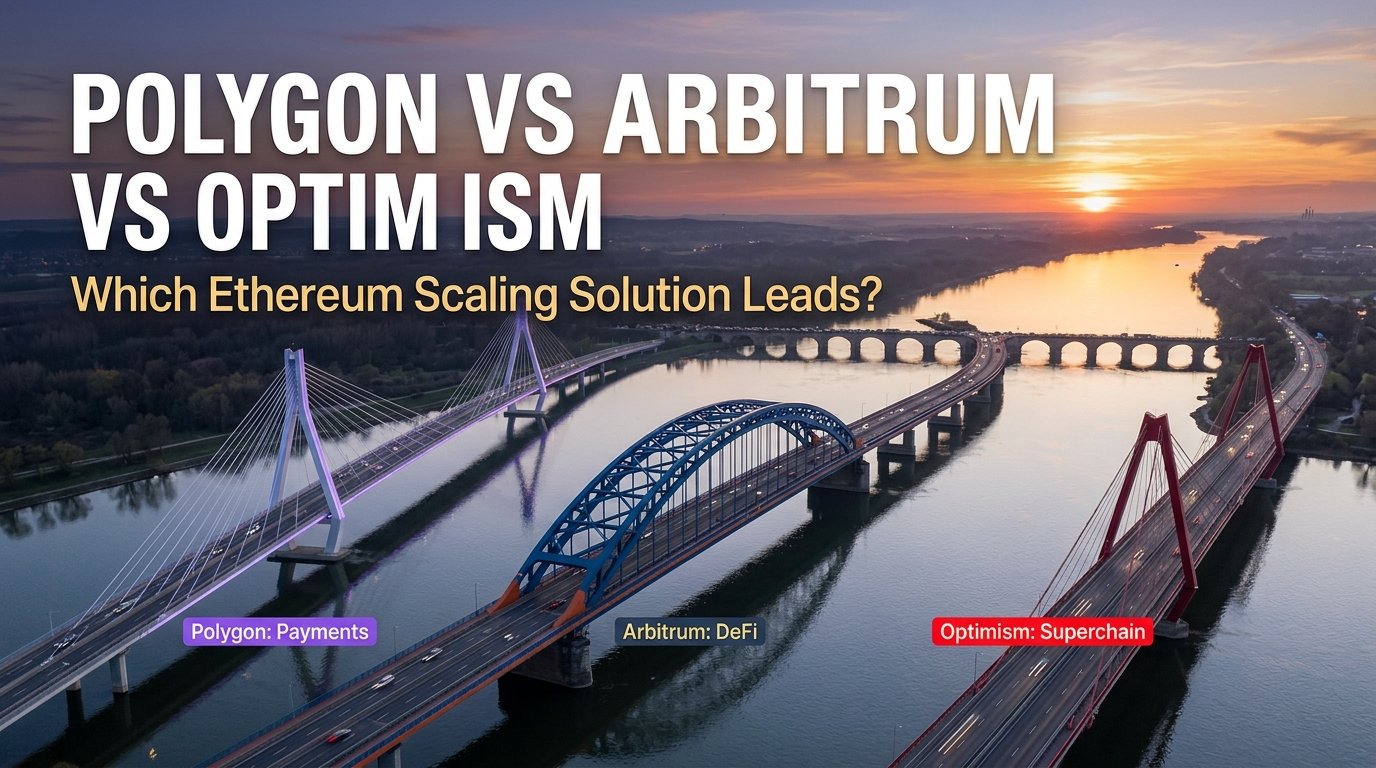
Polygon vs Arbitrum vs Optimism is the debate that almost every Ethereum user reaches sooner or later, because high mainnet fees and congestion push people toward faster networks. All three projects promise cheaper transactions, yet they reach that goal with different designs, tokens and priorities. Polygon leans toward payments and stablecoins, Arbitrum dominates DeFi trading, and Optimism builds a shared network of chains called the Superchain. In this guide, we compare their technology, security, fees, withdrawals, ecosystems and tokens, so you can decide which Ethereum scaling solution leads for your needs. We also flag the main risks, because no network wins in every category.
What Are Ethereum Scaling Solutions?
Ethereum processes a limited number of transactions in each block, so demand pushes gas costs up during busy periods. Scaling solutions move most of the work away from the main chain, while they still lean on Ethereum for safety. Developers group these systems into rollups, sidechains and hybrid frameworks, and each type makes a different trade between speed, cost and security. Understanding these groups makes the three-way comparison much easier to follow.
- Rollups bundle many transactions and post proof or data back to Ethereum.
- Sidechains run their own validators and connect to Ethereum through a bridge.
- Hybrid frameworks let teams launch custom chains that share tools and liquidity.
Polygon vs Arbitrum vs Optimism: Quick Overview
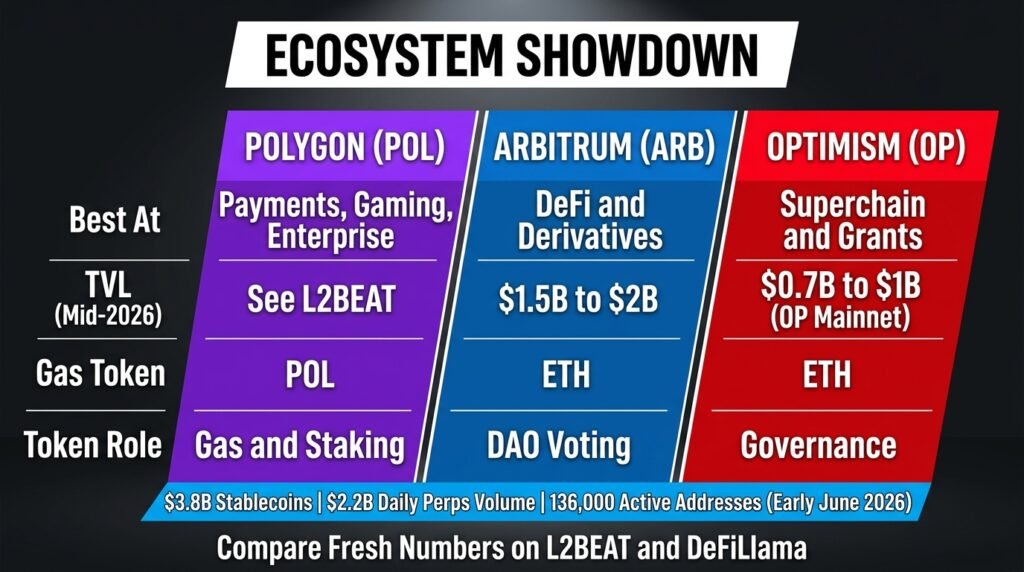
The Polygon vs Arbitrum vs Optimism race looks simple, but each network serves a slightly different crowd. Arbitrum and Optimism both use optimistic rollups, and both charge gas in ETH. Polygon runs a proof-of-stake chain with its own validators and charges gas in POL. Arbitrum leads in DeFi activity, Optimism leads in shared infrastructure, and Polygon leads in low-cost payments and broad enterprise ties. This split explains why users often hold assets on more than one network.
- Polygon: low fees, a payments focus and the POL token for gas and staking.
- Arbitrum: deep DeFi liquidity, Orbit chains and Stylus smart contracts.
- Optimism: the OP Stack and a Superchain that includes Base and World Chain.
How Polygon (POL) Works
Polygon began as a sidechain called Matic and later grew into a family of tools for builders. Its main chain, Polygon PoS, runs its own validators, who stake POL to secure the network. The team swapped MATIC for POL in 2024, and the new token now powers fees and staking across the wider ecosystem. Polygon also offers a Chain Development Kit and an interoperability layer, so teams can launch custom chains that talk to each other. Visit the Polygon website for official documentation.
- Polygon PoS works as a sidechain, not as a pure rollup.
- POL pays gas fees and rewards validators.
- The CDK lets teams launch custom chains with ZK-based options.
How Arbitrum Works
Offchain Labs created Arbitrum, and its main network, Arbitrum One, bundles transactions into batches and posts them to Ethereum. The system assumes each batch is valid unless someone challenges it during a dispute window. This optimistic design keeps costs low and keeps the network fully compatible with Ethereum tools. Developers can also use Orbit to launch their own chains and Stylus to write contracts in languages such as Rust. Explore the Arbitrum documentation to see how it fits your project.
- Arbitrum One serves as the main optimistic rollup for DeFi.
- Orbit lets teams launch app-specific chains.
- Stylus widens the range of languages that builders can use.
How Optimism Works
Optimism also runs an optimistic rollup, but its biggest idea is the OP Stack, an open framework that anyone can use to launch a chain. Many teams adopted it, so the Superchain now links OP Mainnet with Base, World Chain, Mode, Zora and Sonic. These chains share tools and plan to share more infrastructure over time. Optimism also funds public goods through a two-house governance system, which gives the community a voice in grants. Learn more on the Optimism website.
- The OP Stack lowers the cost of launching a new chain.
- The Superchain aims to connect many chains under shared standards.
- Governance funds builders through grants and rewards.
Polygon vs Arbitrum vs Optimism: Security Models
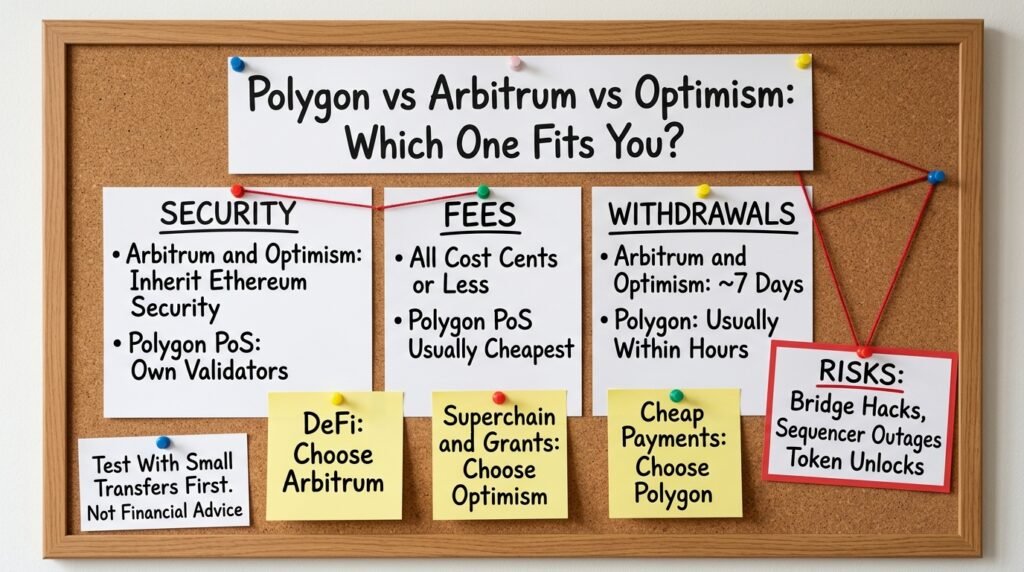
Security shows the sharpest difference in Polygon vs Arbitrum vs Optimism. Arbitrum and Optimism post data to Ethereum, so they inherit much of its security, while challenge rules help catch bad batches. Polygon PoS relies on its own validator set, which means users trust POL staking rather than Ethereum alone. All three networks still depend on a sequencer, the server that orders transactions, and this part remains partly centralized today. Teams have published plans to decentralize it, but progress varies.
- Arbitrum and Optimism inherit Ethereum security through their rollup design.
- Polygon PoS uses its own validators and a separate trust model.
- Centralized sequencers remain a shared weakness across all three.
Polygon vs Arbitrum vs Optimism: Fees and Speed
In the fee race, all three networks cost far less than Ethereum mainnet, usually a few cents or less for a simple transfer. Polygon PoS often looks cheapest, partly because it runs outside the rollup model. Arbitrum and Optimism fees depend on Ethereum data costs, which dropped after recent upgrades. Speed also differs, because each network picks its own block time and confirmation rules. Check live fee data before you move money, since costs change with demand.
- Polygon PoS usually offers the lowest fees.
- Arbitrum uses very quick blocks, which helps active traders.
- Optimism fees follow Ethereum data costs closely.
Withdrawals in Polygon vs Arbitrum vs Optimism
Withdrawals reveal another gap between these networks. Optimistic rollups hold exits for about seven days so challengers can test each claim, and users who cannot wait pay a fast bridge for speed. Polygon PoS bridge exits usually finish in hours instead of days, and ZK-based systems give near-instant proof of validity. This delay matters for traders who move funds between chains often. Plan your exit route before you deposit any large amount.
- Arbitrum and Optimism: roughly seven days on the native bridge.
- Third-party fast bridges shorten the wait for an extra fee.
- Polygon exits usually finish within hours.
Ecosystem Strength: Polygon vs Arbitrum vs Optimism
Ecosystem depth decides where liquidity lives. Arbitrum still leads DeFi, with about $3.8 billion in stablecoins, roughly $2.2 billion in daily perpetuals volume and around 136,000 active addresses in early June 2026. DeFiLlama data from mid-2026 puts Arbitrum near $1.5 to $2 billion in TVL, while OP Mainnet sits near $0.7 to $1 billion. Counting the whole Superchain narrows that gap sharply. Polygon wins in gaming, payments and enterprise pilots. Always compare fresh numbers on L2BEAT.
- Arbitrum holds the deepest DeFi and derivatives liquidity.
- Optimism gains from the combined weight of Superchain networks.
- Polygon attracts gaming studios, payment firms and large brands.
Tokens: POL, ARB and OP
Each network uses a different token model. POL pays gas and secures Polygon PoS through staking. ARB mainly governs the Arbitrum DAO, and Arbitrum users pay gas in ETH, so network growth does not always lift the token. OP also governs Optimism, with ETH as the gas asset, and it faces unlock pressure and heavy competition. Token prices depend on market mood as much as on real usage, so separate the network story from the coin story.
- POL: gas, staking and ecosystem rewards.
- ARB: DAO voting and treasury decisions.
- OP: governance and Superchain funding.
Polygon vs Arbitrum vs Optimism: Who Leads?
No single winner exists, because leadership depends on your goal. Arbitrum leads for DeFi depth and active trading. Optimism leads for shared chain infrastructure and builder grants. Polygon leads for cheap payments, gaming and enterprise ties. Beginners who want low-cost transfers may like Polygon, while active DeFi users often start on Arbitrum. Builders who want their own chain should compare the OP Stack, Orbit and the Polygon CDK before they commit.
- Choose Arbitrum for DeFi liquidity and trading tools.
- Choose Optimism for Superchain access and grants.
- Choose Polygon for low-cost payments and broad adoption.
Risks to Consider
Every option carries risk. Smart contract bugs, bridge hacks and sequencer outages can freeze funds or cause losses. Token prices swing hard, and unlocks add selling pressure. Regulation of staking and governance tokens also remains unclear. Spread your money across networks, test with small transfers first and follow market updates on CoinInDesk. This is not financial advice.
- Use official bridges and double-check every network name.
- Keep only the funds you need on any single chain.
- Read audit reports and governance updates before you deposit.
FAQs About Polygon vs Arbitrum vs Optimism
Is Polygon cheaper than Arbitrum and Optimism?
Polygon PoS usually charges the lowest fees. Arbitrum and Optimism also cost only cents, but their prices follow Ethereum data costs.
Is Polygon a Layer 2?
Polygon PoS works as a sidechain with its own validators. Polygon also builds ZK-based chains that behave more like true Layer 2 networks.
Which network has the highest TVL?
Arbitrum has led for a long time among single chains. Optimism looks stronger when you add the whole Superchain together.
Do I need ETH or POL for gas?
Arbitrum and Optimism use ETH for gas. Polygon PoS uses POL for gas.
Which scaling solution works best for beginners?
Beginners often like Polygon for low fees and Arbitrum for easy DeFi access. Start with small amounts and learn the bridge process first.
Final Thoughts on Polygon vs Arbitrum vs Optimism
The Polygon vs Arbitrum vs Optimism comparison shows three strong networks with different strengths. Arbitrum leads DeFi, Optimism builds the Superchain, and Polygon pushes low-cost payments and adoption. Your best choice depends on your goals, your risk level and the apps you use. Check live data, test with small transfers and stay alert for upgrades. For more daily market news and Ethereum coverage, keep reading CoinInDesk.
