

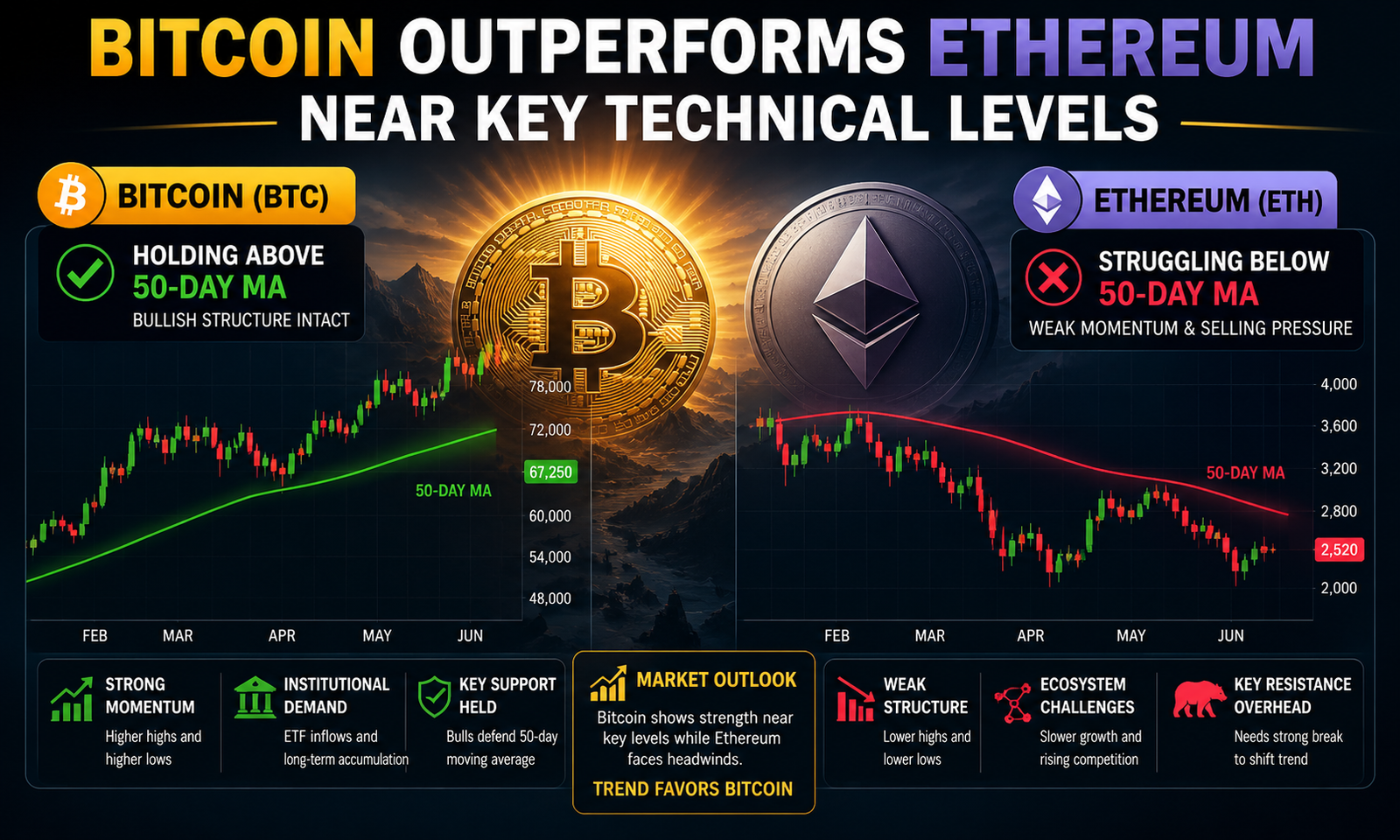
The cryptocurrency market continues to present mixed signals as Bitcoin demonstrates resilience above a critical technical support level while Ethereum struggles to maintain bullish momentum. Traders and investors are closely monitoring price action because the divergence between the two largest digital assets may shape the direction of the broader crypto market in the coming weeks.
Over the past several months, the market has experienced volatility driven by macroeconomic uncertainty, institutional participation, ETF inflows, and changing investor sentiment. Amid these conditions, Bitcoin has managed to hold above its 50-day moving average (MA), reinforcing confidence among bullish traders. Ethereum, on the other hand, has failed to maintain a similar technical structure, causing concerns about weakening momentum and declining buying pressure. The current market setup is particularly important because technical indicators often influence investor psychology. When Bitcoin holds above a major moving average, it typically signals strength and continued market support. Conversely, Ethereum’s inability to reclaim or defend its own support levels may indicate temporary weakness or the possibility of further downside pressure.
As traders analyze charts and search for the next major move, understanding the significance of the 50-day MA, market sentiment, institutional flows, and macroeconomic influences becomes essential. This article explores why Bitcoin is holding above the 50-day MA while Ethereum has failed, what this divergence means for the crypto market, and how investors can interpret the current environment.
The Importance of the 50-Day Moving Average
The 50-day moving average is one of the most widely followed technical indicators in financial markets. It represents the average closing price of an asset over the previous 50 trading days and helps traders identify medium-term market trends. When Bitcoin trades above the 50-day MA, it generally suggests that buyers remain in control and that bullish momentum is still intact. Many institutional traders, hedge funds, and retail investors use this level to determine whether the market trend is healthy or weakening.
MA50=P1+P2+⋯+P5050MA_{50}=\frac{P_1+P_2+\cdots+P_{50}}{50}
In the current market cycle, Bitcoin holding above the 50-day MA indicates that demand remains relatively strong despite broader market uncertainty. This technical structure gives traders confidence that the asset may continue consolidating before another upward move. Ethereum’s situation is different. The second-largest cryptocurrency has repeatedly failed to maintain support near its moving averages, creating concerns about fading momentum. Technical analysts often interpret this as a sign that sellers are gaining control in the short term.
The contrast between the two assets reflects a broader market theme where Bitcoin is outperforming many altcoins. This pattern frequently emerges during uncertain market periods when investors prefer lower-risk crypto assets with stronger institutional backing.
Why Bitcoin Is Showing Strength
Bitcoin’s recent resilience is not accidental. Several factors contribute to its ability to remain above the 50-day MA and maintain relative stability during periods of volatility.
Institutional Demand Continues to Support Bitcoin
One of the main reasons Bitcoin is holding above the 50-day MA is the continued interest from institutional investors. Since the approval and expansion of spot Bitcoin ETFs, institutional capital has steadily entered the market.
Large investment firms view Bitcoin as a digital store of value similar to gold. This perception has strengthened during periods of economic uncertainty and inflation concerns. Institutional accumulation tends to create strong support zones because these investors often hold positions for the long term instead of reacting to short-term price swings. The inflow of institutional capital has also increased market liquidity, reducing the impact of panic selling and helping Bitcoin maintain technical support levels more effectively than many altcoins.
Bitcoin Dominance Is Increasing
Another important factor is the rise in Bitcoin dominance, which measures Bitcoin’s share of the total cryptocurrency market capitalization. When Bitcoin dominance rises, it often means investors are moving capital away from smaller cryptocurrencies and into Bitcoin.
This trend typically occurs during uncertain market conditions because Bitcoin is considered the safest crypto asset relative to altcoins. As capital rotates into Bitcoin, its price structure becomes stronger while other assets, including Ethereum, struggle to keep pace. The increase in Bitcoin dominance reinforces the narrative that Bitcoin remains the market leader and primary institutional focus.
Macroeconomic Conditions Favor Bitcoin
Global macroeconomic trends are also influencing Bitcoin’s performance. Interest rate expectations, inflation data, and monetary policy decisions continue to impact investor behavior. When investors anticipate monetary easing or weakening fiat currencies, Bitcoin often benefits because it is viewed as a hedge against traditional financial instability. Even though the crypto market remains volatile, Bitcoin’s limited supply and growing institutional acceptance provide long-term confidence.
Ethereum, meanwhile, faces additional challenges because its valuation is tied not only to market sentiment but also to network activity, decentralized finance growth, and ecosystem expansion.
Why Ethereum Has Failed to Maintain Momentum
While Bitcoin continues to show strength, Ethereum has struggled to sustain bullish momentum. Several factors explain why Ethereum has failed to hold key support levels and underperformed compared to Bitcoin.
Weakening Altcoin Sentiment
One of the biggest challenges facing Ethereum is the broader weakness in the altcoin market. During periods of uncertainty, investors often reduce exposure to higher-risk assets and concentrate capital in Bitcoin.
Ethereum may be the second-largest cryptocurrency, but it still behaves more like an altcoin in terms of volatility and speculative trading activity. When market sentiment weakens, Ethereum tends to experience stronger price swings than Bitcoin. This shift in investor preference has created selling pressure across the altcoin sector, preventing Ethereum from establishing a strong bullish trend.
Slower Network Growth and Reduced Activity
Ethereum’s price is closely tied to activity on its blockchain network. Decentralized applications, NFT markets, DeFi protocols, and smart contract usage all influence Ethereum demand. However, network growth has slowed compared to previous bull market cycles. Transaction activity, NFT trading volume, and DeFi participation have declined from peak levels, reducing demand for ETH. As network usage weakens, Ethereum loses one of its strongest fundamental drivers. This makes it harder for the asset to sustain rallies during periods of market uncertainty.
Competition From Alternative Blockchains
Ethereum also faces increasing competition from newer blockchain networks offering lower fees and faster transactions. Platforms such as Solana, Avalanche, and Sui have attracted developers and users seeking improved scalability. Although Ethereum remains the dominant smart contract platform, competition has fragmented market attention and reduced Ethereum’s ability to dominate the broader blockchain ecosystem as it once did. This competitive pressure has contributed to Ethereum’s weaker technical performance compared to Bitcoin.
Technical Analysis of Bitcoin and Ethereum
Technical analysis plays a crucial role in understanding current market conditions. The divergence between Bitcoin and Ethereum becomes especially clear when examining chart structures and moving averages.
Ethereum Faces Key Resistance Levels
Ethereum’s chart structure appears less favorable. The asset has repeatedly failed to reclaim important resistance zones and remains vulnerable to additional downside pressure. Lower highs and weaker rebounds indicate that buyers are less aggressive compared to previous rallies. If Ethereum cannot regain momentum soon, traders may continue rotating capital into Bitcoin and other stronger-performing assets. The divergence between Bitcoin and Ethereum highlights the importance of relative strength analysis in crypto markets.
Investor Psychology and Market Sentiment
Market sentiment plays a major role in cryptocurrency price action. Fear, uncertainty, and optimism can quickly shift investor behavior, especially in highly volatile environments.
Bitcoin Benefits From Confidence
Bitcoin’s ability to hold above the 50-day MA creates psychological confidence among traders. When a major asset maintains key support levels, investors often interpret it as a sign of underlying strength. This confidence encourages dip-buying behavior, where traders purchase Bitcoin during short-term corrections. The cycle of buying support reinforces the bullish structure and helps stabilize prices.
Ethereum Faces Sentiment Challenges
Ethereum’s failure to maintain support levels creates the opposite effect. Traders become cautious when an asset repeatedly loses momentum because it increases the risk of larger declines. Negative sentiment can accelerate selling pressure as investors move capital into safer or stronger-performing assets. This shift further weakens Ethereum’s price structure and makes recovery more difficult. Psychology often amplifies technical trends, which is why the divergence between Bitcoin and Ethereum is receiving significant attention.
The Role of Spot ETFs and Institutional Flows
Institutional products such as spot Bitcoin ETFs have fundamentally changed market dynamics. Bitcoin now has greater exposure to traditional financial markets than ever before.
Bitcoin ETFs Continue to Attract Capital
Spot Bitcoin ETFs have created a simple and regulated way for institutional investors to gain exposure to Bitcoin. Pension funds, asset managers, and corporate investors can now participate without directly holding cryptocurrency.
This consistent inflow of institutional capital provides structural support for Bitcoin prices and strengthens long-term demand. The ETF narrative has become one of the most important drivers behind Bitcoin’s resilience above the 50-day MA.
Ethereum ETFs Have Had a Smaller Impact
Although Ethereum ETF products have generated interest, they have not matched the same level of enthusiasm as Bitcoin ETFs. Investors still view Bitcoin as the primary institutional crypto asset, while Ethereum remains associated with higher volatility and ecosystem-related risks.
This difference in institutional demand partly explains why Ethereum has failed to match Bitcoin’s strength in recent months.
Could Ethereum Recover?
Despite recent weakness, Ethereum still has significant long-term potential. The blockchain remains a dominant force in decentralized finance, smart contracts, and Web3 development.
Upcoming Upgrades Could Improve Sentiment
Ethereum developers continue working on scalability improvements and network upgrades designed to reduce fees and improve efficiency. If these upgrades successfully enhance user experience and attract more developers, Ethereum could regain momentum and strengthen its market position.
Positive developments within the Ethereum ecosystem may eventually reverse bearish sentiment and encourage renewed investor confidence.
Altcoin Season Could Return
Historically, altcoins tend to outperform Bitcoin during certain phases of the market cycle. If market sentiment improves and liquidity increases, Ethereum could benefit from renewed speculative interest. An eventual altcoin season may help Ethereum recover technical support levels and narrow the performance gap with Bitcoin.
However, for now, Bitcoin remains the dominant market leader.
What Traders Should Watch Next
The coming weeks will likely determine whether the current divergence continues or reverses. Traders are closely watching several important indicators.
Bitcoin’s Ability to Hold the 50-Day MA
Bitcoin remaining above the 50-day moving average is critical for maintaining bullish momentum. A decisive break below this level could weaken sentiment and trigger broader market selling. As long as Bitcoin defends this support zone, traders may continue viewing pullbacks as buying opportunities.
Ethereum’s Reaction Near Support Levels
Ethereum must stabilize near key support areas and reclaim lost momentum to avoid deeper corrections. A strong rebound accompanied by increasing volume could signal renewed buyer interest. Without this recovery, Ethereum may continue underperforming relative to Bitcoin.
Broader Macroeconomic Developments
Inflation data, Federal Reserve policy decisions, and global economic trends will continue influencing cryptocurrency markets. Any signs of monetary easing or increased liquidity could support risk assets, including Bitcoin and Ethereum. Conversely, tighter financial conditions may increase market volatility.
The Bigger Picture for the Crypto Market
The divergence between Bitcoin and Ethereum reflects a broader transition within the cryptocurrency industry. Institutional adoption is increasingly concentrated around Bitcoin, while altcoins face greater scrutiny and competition. This shift does not necessarily mean Ethereum’s long-term future is weak. Instead, it highlights how different narratives influence market cycles.
Bitcoin currently benefits from the digital gold narrative, ETF adoption, and strong institutional demand. Ethereum, meanwhile, remains tied to blockchain innovation, decentralized applications, and ecosystem growth. Both assets continue to play major roles in the future of digital finance, but their short-term market behavior may differ significantly.
Bitcoin holding above the 50-day MA while Ethereum has failed illustrates the growing divergence within the cryptocurrency market. Bitcoin’s resilience reflects strong institutional demand, rising market dominance, and positive investor sentiment. Ethereum, however, continues facing challenges related to weaker altcoin sentiment, slowing network activity, and increasing competition from alternative blockchains. The current market structure suggests that Bitcoin remains the preferred choice for investors seeking stability within the crypto sector. Ethereum still holds long-term potential, but it must regain technical strength and ecosystem momentum to restore confidence.
As market conditions evolve, traders and investors should closely monitor technical indicators, institutional flows, and macroeconomic developments. The next major move in the crypto market may depend on whether Bitcoin can maintain its bullish structure and whether Ethereum can recover from its recent weakness.
