

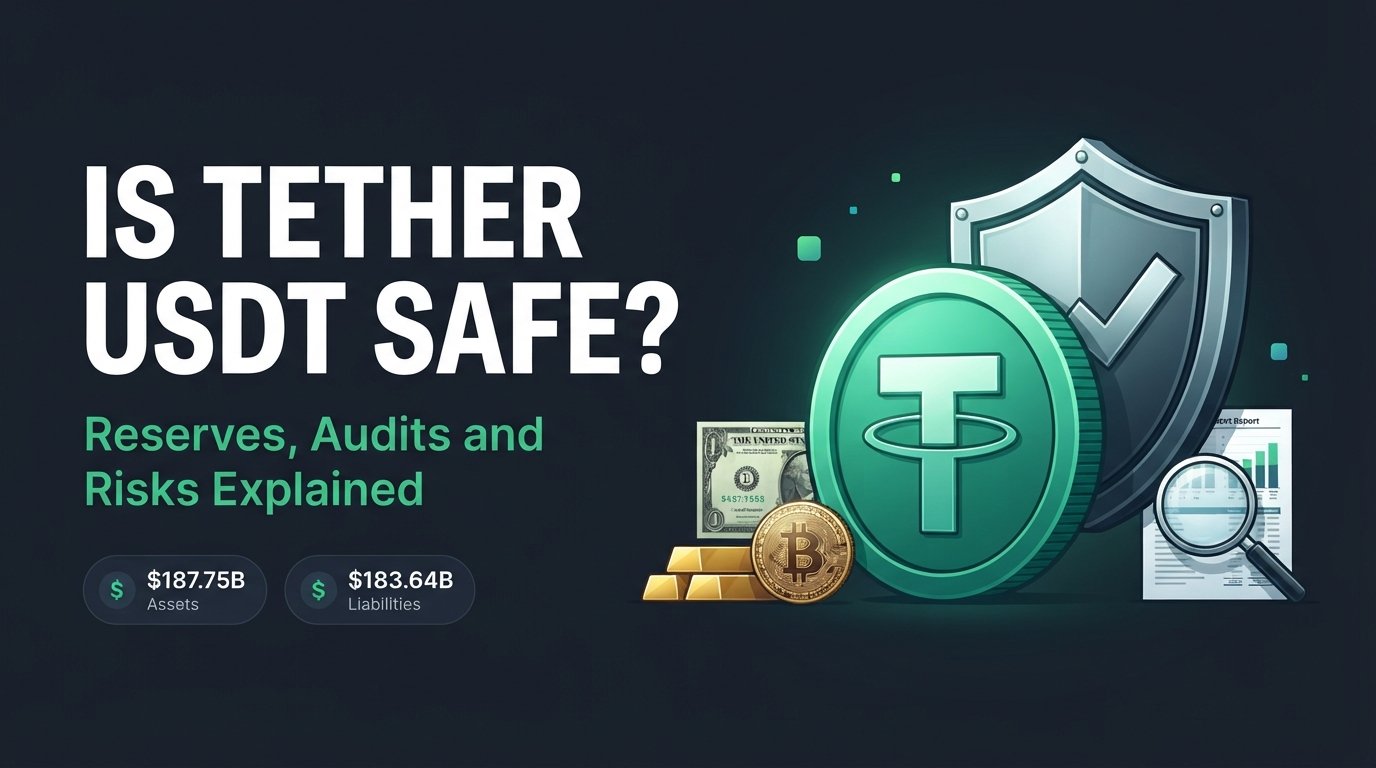
Is Tether USDT safe? It is a fair question, because USDT holds more than 60 percent of the stablecoin market and moves billions of dollars every day. Tether says every token is fully backed, and its latest report supports that claim, yet its reserve cushion shrank sharply this year. Auditors have also not finished the first full audit in the company’s history. In this guide, we explain what backs USDT, what the newest report shows, how audits differ from attestations, and which risks you should consider before you hold the coin.
What Is Tether USDT?
Tether USDT is a stablecoin that aims to keep a value of one US dollar. Tether launched the token years ago, and it now circulates at more than $180 billion across many blockchains. Traders use USDT to move money between exchanges, to park profits during market drops,s and to send dollars across borders. Because so many people rely on this coin, the question of whether Tether USDT is safe matters for the whole crypto market, not only for individual holders.
Is Tether USDT Safe? What the Latest Reserve Report Shows
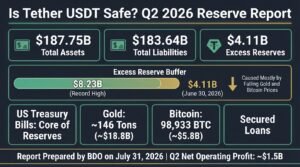
Tether released its newest attestation at the end of July 2026, and the accounting firm BDO prepared it. The report covers the company’s position on June 30. On that date, the assets stood roughly $4 billion above what Tether owes to token holders, so every USDT had backing and a cushion remained. The company also reported about $1.5 billion in operating profit for the quarter. So, is Tether USDT safe on the numbers alone? The data looks solid, but one report cannot remove every risk. You can check the full figures on Tether’s transparency page.
What Backs USDT: Treasuries, Gold and Bitcoin
US Treasury bills form the core of the reserves, and Tether ranks among the largest holders of these bonds in the world. The company also holds gold, Bitcoin, and secured loans. Its gold position grew by 14 tons in the second quarter and now sits near 146 tons, worth about $18.8 billion. Tether also holds 98,933 BTC, which carried a value of about $5.8 billion. These assets add return, but they also add price swings. A Tether USDT safe rating therefore depends on how well the company manages these riskier holdings.
Why the Excess Reserve Buffer Halved
Tether’s safety margin dropped from about $8.2 billion to about $4.1 billion within one quarter. The report’s capital table also showed a loss of roughly $3.2 billion for the first half of the year. Critics use this figure to question whether Tether USDT is safe if a long downturn arrives. Supporters answer that USDT kept full coverage and held its dollar price throughout. Weigh both arguments before you decide how much to hold.
Attestations vs Audits: Where KPMG Fits
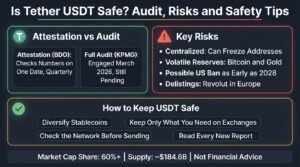
For many years, Tether published attestations instead of audits. An attestation checks whether specific figures match on a single date, while a full audit studies the entire financial statements in far greater depth. This step answers a long-running complaint about transparency. Until KPMG releases its findings, final proof stays pending whenever you ask whether Tether USDT is safe. BeInCrypto explains the latest quarterly numbers.
Is Tether USDT Safe During Market Stress?
USDT has survived several market shocks and regained its dollar price each time. During the volatile second quarter of 2026, the token kept its peg even as the company’s gold and Bitcoin positions lost value. Supply kept growing too, and total issuance reached about $184.6 billion. Such results build trust, but history never guarantees the future. A sudden wave of redemptions could still test the reserves. Careful traders therefore split their money across multiple stablecoins instead of relying on a single issuer.
Key Risks of Holding USDT
Even if you trust the reserve data, USDT carries risks. Tether is a single company, so it can freeze wallets and block transfers. The Bitcoin and gold in its reserves can lose value quickly. Until a full audit arrives, you rely on attestations rather than verified statements. Treat USDT as a trading tool, not as a long-term savings account.
Regulation and Access Risks
Stablecoin rules keep tightening across the world. European platforms already restrict USDT trading under local law. Such changes can cut liquidity or force you to switch coins on short notice. Check your country’s rules before you hold large amounts, and track updates on CoinInDesk. This is not financial advice.
How to Keep Tether USDT Safe
Spread your stablecoins across USDT and at least one other regulated coin. Always check the network before you send USDT, because the wrong network can cost you your funds. Read each new Tether report when it comes out, and watch for the first KPMG audit. Then you can judge whether Tether USDT is safe for your own goals, not only for the market.
FAQs: Is Tether USDT Safe?
Is Tether USDT safe to hold?
It carries lower risk than most crypto assets, but it is not risk-free. Reserves exceed liabilities today, yet the company is centralized and still awaits a full audit.
What backs USDT?
Tether keeps mostly US government debt in its reserves, along with gold, Bitcoin, and collateralized loans.
Has Tether passed a full audit?
Not yet. The company hired KPMG in March 2026, and until that audit ends, BDO keeps issuing quarterly attestations.
Can USDT lose its peg?
Yes, any stablecoin can lose its peg during a crisis. USDT has recovered quickly in past stress events, but no guarantee exists.
Is USDT legal in the US?
You can trade it today on many platforms, but new federal rules for issuers could limit it in the future.
Final Thoughts: Is Tether USDT Safe to Hold?
The latest data says USDT remains fully backed, and the new KPMG audit could finally give the market the proof it wants. At the same time, the shrinking buffer, the volatile reserve assets,s and the regulatory pressure show real risks. Use USDT for trading and payments, diversify your stablecoins, and never keep more on an exchange than you need. Read every new report with a critical eye, and keep following daily market news at CoinInDesk.
