


How Polkadot works is one of the most common questions among new crypto learners, because the network uses a design that looks very different from Bitcoin or Ethereum. Instead of one chain that does everything, Polkadot connects many specialized blockchains to one central chain that protects them all. In March 2026, the network also changed its token rules by adding a hard supply cap. In this guide, we explain each major part step by step, including the Relay Chain, parachains, shared security, coretime, the DOT token, and the upcoming JAM upgrade. We also cover the risks so that you can judge the project with a clear mind.
What Is Polkadot?
Polkadot is a Layer-0 network, meaning it sits beneath other blockchains and connects them instead of competing with them directly. Many people call it a “blockchain of blockchains.” Developers use it to launch their own chains without building a full security system from scratch. The idea solves a long-standing problem because most blockchains work alone and struggle to talk to each other. Polkadot gives them a shared home with common rules and a shared safety net.
Key points about Polkadot:
- It links specialized blockchains into one network.
- It lets each chain keep its own rules and features.
- It uses DOT as its native token.
- You can explore the official project on the Polkadot website.
How Polkadot Works: The Big Picture
To understand how Polkadot works, picture a country with a central government and many states. The central government, called the Relay Chain, handles security and coordination. The states, called parachains, run their own apps and local rules. Each parachain sends its blocks to the Relay Chain, and a pool of validators checks them. Once the validators approve a block, it becomes final for the entire network. This split of duties lets every chain focus on its own job while the center keeps order.
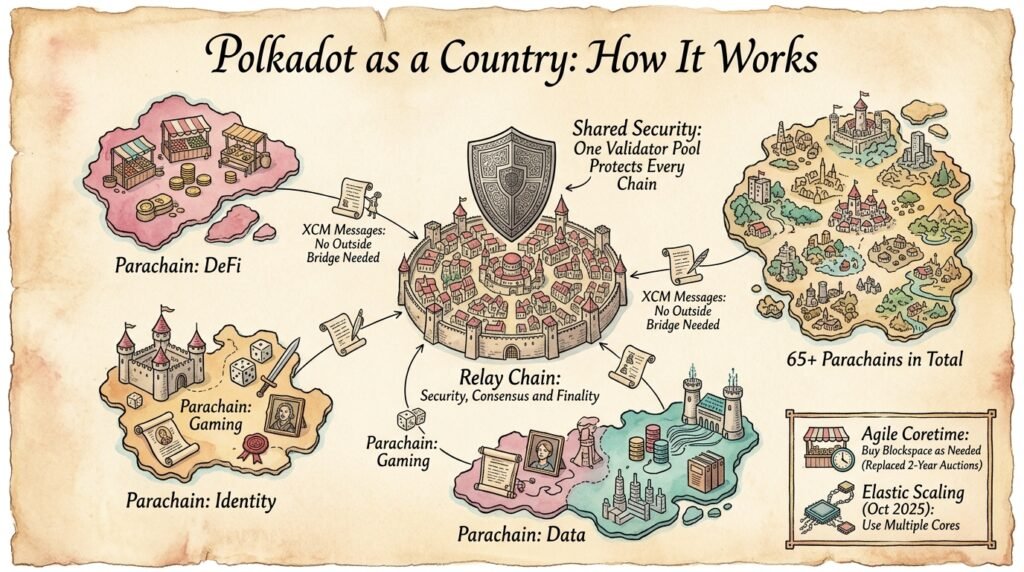
The main building blocks include:
- The Relay Chain for security, consensus, and finality
- Parachains for apps, finance, gaming, and identity tools
- Validators who check every parachain block
- XCM messages that move data and assets between chains
The Relay Chain: Polkadot’s Core Layer
The Relay Chain acts as the heart of the network. It does not run apps, smart contracts,s or games by itself. Instead, it focuses on three tasks: it reaches agreement on the network’s state, it finalizes blocks, ks and it carries messages between connected chains. This narrow focus keeps the system fast and simple at the center. Because the Relay Chain avoids heavy app logic, it can serve many parachains at the same time without slowing down.
What the Relay Chain does:
- Collects block candidates from every parachain
- Asks validators to verify each candidate
- Finalizes approved blocks for all chains at once
- Coordinates messages between parachains
Parachains: Specialized Blockchains on Polkadot
Parachains are independent blockchains that run in parallel next to each other. Each one serves a clear purpose, such as DeFi, gaming, data storage, or digital identity. Developers choose their own rules, fee models, and token designs, so they enjoy far more freedom than they would on a general-purpose chain. At the same time, they connect to the Relay Chain and use its protection. Reports count more than 65 parachains, and some of them support Ethereum-style apps, which makes it easier for Ethereum developers to move over.
Benefits for builders:
- Custom design for each application
- Parallel processing, so one busy chain does not block the others
- Simple connection to the wider Polkadot network
- No need to recruit a private validator group
Shared Security: A Key Part of How Polkadot Works
Shared security forms the main advantage of the network. On most blockchains, a new project must attract its own validators, and that process is slow and costly. A weak validator group also invites attacks. On Polkadot, every parachain uses the same large validator pool, so a new chain receives full protection from its first day. Validators check parachain blocks and earn rewards for honest work, while the network can slash dishonest ones.
Why shared security matters:
- Small projects gain the strength of a big network
- Attackers must beat the whole validator set, not one small group
- Developers save time and money on security
- Cross-chain messages travel under the same trust rules
How Polkadot Works With Agile Coretime
Polkadot used to sell parachain slots through long auctions, which required teams to lock large amounts of DOT for up to two years. Agile Coretime replaced that model with flexible purchases of blockspace. Teams now buy computing time on the Relay Chain in the amount they need, and they can pay for a short period instead of a long lease. This change lowers the entry cost and suits young projects. Elastic Scaling, which finished in October 2025, also lets a parachain use several cores at once during busy periods.
Main features of Plokadot work:
- Pay only for the blockspace you need
- Scale up during traffic spikes
- Lower upfront cost for new projects
- Revenue from coretime sales supports network security
XCM: Cross-Chain Messaging Between Parachains about Polkadot Work
XCM stands for cross-consensus messaging, and it serves as Polkadot’s built-in language for communication. A parachain can use XCM to send tokens, instructions, or data to another parachain. Because the same Relay Chain validators secure both sides, the transfer does not depend on an outside bridge with its own risks. This design reduces a major weak point that has caused many hacks across the crypto industry. XCM also lets developers build apps that combine features from several chains in one smooth experience.
What XCM allows:
- Asset transfers between parachains
- Cross-chain contract calls and instructions
- Shared liquidity across the ecosystem
- Fewer trust assumptions than third-party bridges
DOT Token: Staking, Governance and the 2.1 Billion Cap
DOT powers the whole network, and it does three main jobs. Holders stake it to secure the chain and earn rewards; they vote on upgrades through on-chain governance; and teams use it to buy coretime. In March 2026, a governance vote with about 81 percent approval enacted runtime version 2.1.0. That upgrade set a hard cap of 2.1 billion DOT and cut yearly issuance by roughly 53.6 percent, from about 120 million tokens to about 55 million. Before that change, DOT had no maximum supply. You can track market data on The Block’s DOT page.
Quick token facts:
- Total supply cap: 2.1 billion DOT
- Circulating supply: roughly 1.67 billion DOT
- Staking share: more than half of the circulating supply
- Main uses: staking, governance, and coretime
JAM: What Changes Next for Polkadot
JAM, short for Join-Accumulate Machine, represents the next big step on the roadmap. It aims to replace the current Relay Chain with a more general computation engine that can process many kinds of workloads, not only parachain blocks. Some writers call this stage Polkadot 3.0. Testnet milestones target the second half of 2026, so the project still needs time before full release. If JAM works as planned, developers could build a wider range of apps with more flexibility. The Coin Bureau review offers a deeper look at this upgrade.

What to watch:
- Testnet progress during late 2026
- Governance votes on the transition
- Developer interest in the new model
- Impact on coretime demand
Risks and Limits of Polkadot Work
Polkadot offers strong technology, but it also faces real challenges. DOT fell more than 90 percent from its 2021 peak and now trades below $1, which shows how much market confidence has dropped. Rival networks fight for the same developers and users, and the design can feel complex for beginners. Coretime revenue must grow to support security as new issuance falls. Bridges that connect Polkadot to outside chains have also seen security problems. Never invest more than you can afford to lose, and read daily updates on CoinInDesk. This is not financial advice.
Main risks:
- Sharp price drops and weak market mood
- Strong competition from other ecosystems
- Technical complexity for newcomers
- Execution risk around the JAM upgrade
FAQs About How Polkadot Works
Howdoes Polkadot work in simple words?
Polkadot links many specialized blockchains to one central chain. The central chain, called the Relay Chain, secures them all, and each blockchain handles its own apps.
What is the Relay Chain?
The Relay Chain is the main chain of Polkadot. It handles consensus, finality, a nd security for every connected parachain.
What is a parachain?
A parachain is an independent blockchain that connects to the Relay Chain. It keeps its own rules and uses the shared security of the network.
What is the maximum supply of DOT?
The maximum supply of DOT is 2.1 billion tokens. The cap took effect with the March 2026 runtime upgrade.
Is Polkadot a good investment?
Polkadot carries high risk. The technology looks strong, but price swings, competition, and upgrade delays can hurt returns, so research carefully first.
Final Thoughts on How Polkadot Works
How Polkadot works comes down to one clear idea: share security and let specialized chains do the rest. The Relay Chain protects, parachains build, XCM connects,s and DOT pays for the system. The 2026 supply cap and the JAM roadmap show that the project keeps evolving, even after a rough market. Still, price risk and strong competition remain, so study the network before you invest and follow trusted sources. For more daily crypto news and market analysis, keep reading CoinInDesk.
