

For years, cryptocurrency investors relied on a familiar market cycle. Bitcoin would rally first, attracting institutional and retail capital, and then profits would rotate into alternative cryptocurrencies, creating explosive gains across the broader digital asset market. This phenomenon became known as the Bitcoin-to-altcoin rotation and was a defining characteristic of previous crypto bull markets.
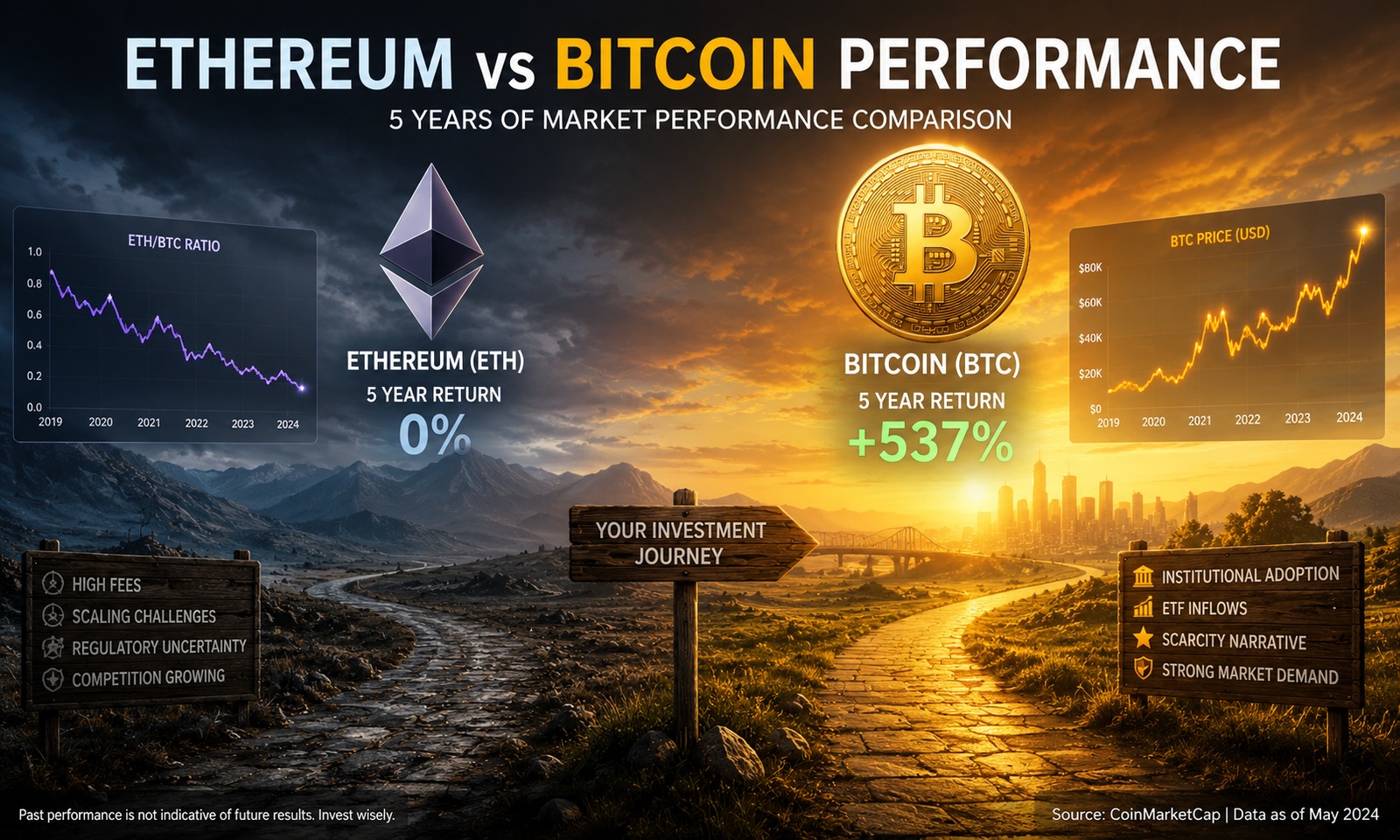
However, recent market data suggests that this traditional cycle may be changing dramatically. While Bitcoin has continued to reach new milestones and attract unprecedented institutional demand, Ethereum—the second-largest cryptocurrency by market capitalization—has struggled to generate meaningful long-term returns. In fact, analysts now argue that Ethereum has delivered effectively zero returns over the past five years when compared with Bitcoin’s remarkable performance.
This development has sparked intense debate across the cryptocurrency industry. Investors are questioning whether the historical relationship between Bitcoin and altcoins still exists and whether the age of automatic capital rotation into alternative digital assets has come to an end. The growing dominance of Bitcoin, the rise of institutional investment vehicles, and changing market dynamics have created a new environment where Bitcoin dominance, Ethereum performance, altcoin season, and crypto market cycles are being reevaluated by traders and analysts alike.
The Traditional Bitcoin-to-Altcoin Rotation
Historically, cryptocurrency markets followed a relatively predictable pattern. Bitcoin would lead the market higher, benefiting from increased investor confidence and inflows. Once Bitcoin’s rally slowed, investors would seek higher returns in altcoins, particularly Ethereum and other large-cap digital assets. This process created substantial wealth during previous bull markets. Ethereum often outperformed Bitcoin during the later stages of market expansions, while smaller altcoins generated even larger percentage gains.
The logic behind this rotation was straightforward. Bitcoin served as the entry point into cryptocurrency markets, while altcoins offered greater growth potential due to their smaller market capitalizations. As investor confidence increased, risk appetite expanded, encouraging capital to move further down the risk curve. For years, this strategy appeared highly effective and became a core assumption underlying many crypto investment models.
Why Ethereum’s Performance Has Become a Major Concern
Ethereum remains one of the most influential blockchain networks in the world. It powers decentralized finance applications, non-fungible tokens, smart contracts, and countless blockchain-based innovations. Despite its technological importance, its market performance has increasingly disappointed investors.
Ethereum’s Relative Underperformance Against Bitcoin
While Ethereum has experienced periods of strong price appreciation, its performance relative to Bitcoin has weakened considerably. Investors who allocated capital to Ethereum instead of Bitcoin over certain long-term periods have often seen inferior returns.
This trend has challenged the long-standing belief that Ethereum naturally benefits from every Bitcoin bull market. Instead, Bitcoin has increasingly captured the majority of institutional inflows, leaving Ethereum struggling to maintain its historical momentum. The declining ETH/BTC ratio has become a focal point for analysts who view it as evidence that capital rotation within the cryptocurrency market is weakening.
Institutional Demand Favors Bitcoin
One of the primary reasons behind Ethereum’s underperformance is the overwhelming institutional preference for Bitcoin. Large asset managers, hedge funds, pension funds, and corporations often view Bitcoin as digital gold. Its simplicity, scarcity, and established reputation make it easier for institutions to understand and justify as an investment.
Bitcoin exchange-traded funds have further strengthened this trend. These products provide traditional investors with convenient access to Bitcoin exposure without requiring direct ownership of cryptocurrencies. As a result, substantial amounts of capital that might previously have flowed into Ethereum or other altcoins are now remaining concentrated in Bitcoin.
The Growing Dominance of Bitcoin in Crypto Markets
Bitcoin dominance refers to Bitcoin’s share of the total cryptocurrency market capitalization. Rising dominance often indicates that investors are favoring Bitcoin over alternative digital assets.
A Shift in Market Structure
The cryptocurrency market today looks significantly different from previous cycles. Earlier bull markets were heavily driven by retail investors seeking speculative opportunities. Today’s market increasingly includes institutions focused on risk management and long-term portfolio allocation.
Institutional investors generally prioritize liquidity, security, regulatory clarity, and brand recognition. Bitcoin excels in all of these areas. Consequently, the market structure has evolved from a speculative ecosystem fueled by retail enthusiasm into a more mature environment where institutional preferences exert greater influence.
Bitcoin’s Digital Gold Narrative
The digital gold narrative continues to strengthen Bitcoin’s position. Many investors now view Bitcoin as a hedge against inflation, currency debasement, and geopolitical uncertainty.
Unlike Ethereum, which must continually evolve through upgrades and protocol changes, Bitcoin maintains a relatively stable monetary policy. This predictability appeals to conservative investors seeking long-term stores of value. As confidence in Bitcoin’s role as digital gold grows, capital increasingly bypasses Ethereum and flows directly into Bitcoin.
Has Altcoin Season Lost Its Power?
The concept of altcoin season has been a cornerstone of cryptocurrency investing for years. During these periods, altcoins outperform Bitcoin and generate extraordinary returns. Recent market behavior, however, suggests that altcoin seasons may be becoming less powerful and less predictable.
The Decline of Broad-Based Altcoin Rallies
Previous crypto cycles often lifted nearly all altcoins simultaneously. Today, gains appear more concentrated among a limited number of projects with strong fundamentals or unique narratives.
Instead of widespread rallies, investors are becoming increasingly selective. Projects lacking clear utility, strong development activity, or sustainable adoption struggle to attract capital. This shift reduces the likelihood of a broad market rotation similar to those seen in 2017 and 2021.
Increased Competition Among Blockchain Networks
Ethereum now faces intense competition from alternative smart contract platforms. Networks focused on scalability, lower fees, and improved user experiences have attracted developers and users.
As capital spreads across multiple ecosystems, Ethereum’s ability to dominate the altcoin market has weakened. Investors now have a wider range of opportunities, reducing the concentration of capital that previously benefited Ethereum.
Factors Behind Ethereum’s Stagnant Long-Term Returns
Several structural challenges have contributed to Ethereum’s disappointing long-term performance relative to Bitcoin.
Regulatory Uncertainty
Regulatory concerns remain a significant factor affecting investor sentiment toward Ethereum. While Bitcoin is increasingly recognized as a commodity in many jurisdictions, Ethereum’s regulatory classification has generated ongoing debate. This uncertainty can discourage institutional participation and limit capital inflows. Investors generally prefer assets with clearer regulatory frameworks, giving Bitcoin an advantage.
Complexity Compared to Bitcoin
Bitcoin’s investment thesis is straightforward. It is a scarce digital asset with a fixed supply and a decentralized network. Ethereum’s value proposition is more complex. Investors must understand smart contracts, staking, decentralized applications, layer-two solutions, and evolving tokenomics.
This complexity can create barriers to adoption, particularly among traditional investors entering the cryptocurrency space.
Changing Investor Priorities
The cryptocurrency market is maturing. Investors increasingly prioritize risk-adjusted returns rather than purely speculative gains.
Bitcoin’s established track record and lower perceived risk make it an attractive option for institutional portfolios. Ethereum, despite its innovation, faces greater scrutiny regarding competition, scalability, and long-term value capture.
The Impact of Bitcoin ETFs on Capital Flows
The introduction of Bitcoin exchange-traded funds represents one of the most important developments in cryptocurrency history.
A New Source of Demand
Bitcoin ETFs have opened the door to billions of dollars in institutional capital. Investors who previously lacked access to cryptocurrency markets can now gain exposure through traditional brokerage accounts. This accessibility has created a powerful demand engine for Bitcoin. As ETF inflows continue, Bitcoin attracts capital that might otherwise have diversified into Ethereum or other digital assets.
Concentration of Market Attention
Media coverage, analyst reports, and institutional research increasingly focus on Bitcoin due to the success of ETF products. This concentration of attention reinforces Bitcoin’s dominant position and creates a self-reinforcing cycle of demand, visibility, and investment. Ethereum must compete not only with Bitcoin itself but also with the growing ecosystem supporting Bitcoin investment products.
Could Ethereum Recover Its Leadership Position?
Despite recent challenges, many analysts believe Ethereum still possesses significant long-term potential.
Strength of the Ethereum Ecosystem
Ethereum remains the leading platform for decentralized finance, smart contracts, and blockchain innovation. Developers continue building applications on Ethereum, and its ecosystem remains one of the most active in the cryptocurrency industry. Strong network effects provide a foundation for future growth, even if current market performance appears disappointing.
Technological Improvements
Ongoing upgrades aimed at improving scalability, efficiency, and transaction costs could enhance Ethereum’s competitiveness. As adoption expands and technological improvements take effect, Ethereum may regain investor confidence and attract renewed capital inflows.
Potential for Future Rotation
While Bitcoin-to-altcoin rotation appears weaker today, market cycles continue to evolve. Future catalysts, including regulatory clarity, technological breakthroughs, and broader cryptocurrency adoption, could reignite demand for Ethereum and other altcoins. History demonstrates that cryptocurrency markets can change rapidly, making long-term predictions inherently uncertain.
What This Means for Crypto Investors
The apparent disappearance of traditional Bitcoin-to-altcoin rotation has important implications for investors. Rather than assuming that all altcoins will eventually benefit from Bitcoin rallies, investors may need to adopt a more selective approach.
Fundamental analysis, ecosystem strength, adoption metrics, and real-world utility are becoming increasingly important factors in investment decisions. The era of indiscriminate altcoin speculation may be giving way to a more mature market driven by institutional capital and sustainable value creation. For investors, understanding these evolving dynamics is essential for navigating future cryptocurrency cycles successfully.
Conclusion
The claim that Ethereum delivered zero returns over five years compared to Bitcoin highlights a significant shift in cryptocurrency market dynamics. Bitcoin’s growing dominance, fueled by institutional adoption, ETF inflows, and its digital gold narrative, has altered the traditional relationship between Bitcoin and altcoins. The once-reliable Bitcoin-to-altcoin rotation appears weaker than in previous cycles, raising questions about the future of altcoin seasons and Ethereum’s role within the broader market.
Nevertheless, Ethereum remains a critical component of the blockchain ecosystem, powering innovation across decentralized finance, smart contracts, and digital applications. While recent performance has disappointed some investors, Ethereum’s technological strengths and active development community continue to support its long-term potential.
As the cryptocurrency market matures, investors must adapt to a changing landscape where capital allocation decisions are increasingly influenced by institutional participation, regulatory developments, and real-world utility rather than speculative momentum alone.
