

This Uniswap investment review examines whether the largest decentralized exchange still deserves a place in a serious crypto portfolio. Uniswap launched in 2018 and quickly became the default venue for swapping tokens on Ethereum without a middleman. Today it runs across many networks and processes billions of dollars in trading volume. Investors now focus on one big question: can the UNI token finally capture value from that activity? Governance has put the fee switch debate at the center of the story, and it changes how analysts value the protocol. This article explains how Uniswap works, why it leads the DEX market, what the fee switch means, and which risks matter most. You will also find a clear view of long-term potential, plus answers to common questions. Read each section carefully before you make any investment decision.
What Is Uniswap (UNI)?
Uniswap is a decentralized exchange that lets users swap crypto tokens directly from their own wallets. Hayden Adams built the first version after he studied an idea that Ethereum co-founder Vitalik Buterin had shared about automated market makers. The protocol replaced the traditional order book with smart contracts that hold pooled funds. Anyone can list a token, and anyone can trade it, so no company approves or blocks listings. Uniswap Labs builds the main web interface and wallet products, while the Uniswap Foundation and the community fund ecosystem grow. The protocol code is open source, and developers around the world build on it every day. Many other DeFi apps use Uniswap pools as a price source. That deep integration makes Uniswap one of the core pieces of public blockchain infrastructure. The UNI token, launched in 2020, gives holders a voice in how the protocol evolves. You can read the official documentation in the Uniswap developer docs to see the technical details.
How Uniswap Works: The Automated Market Maker Model
Uniswap relies on an automated market maker, often called an AMM, to set prices and execute trades. Instead of matching buyers with sellers, the protocol uses a mathematical formula to price tokens inside each pool. When a trader buys one token, the pool balance shifts, and the formula adjusts the price automatically. Larger trades move the price more, which traders call slippage. Smart contracts handle every step, so users keep custody of their assets until the swap completes. This design removes the need for centralized market makers and lets markets exist for tokens of any size. It also allows trading around the clock without downtime. The model has limits, though, because pools need enough liquidity to keep slippage low. Uniswap solved part of that problem by letting liquidity providers choose specific price ranges. Aggregators and wallets also route orders through Uniswap, which brings even more volume to the protocol. Readers who want more background on DeFi trading can explore more guides on coinindesk.com.
Liquidity Pools and Liquidity Providers
Liquidity providers, or LPs, supply the tokens that make every Uniswap trade possible. Each LP deposits two assets into a pool and receives a position that tracks their share. Every time a trader swaps through that pool, the trader pays a fee, and the protocol distributes most of that fee to the LPs. This structure gives users a way to earn income from assets that would otherwise sit idle. However, LPs face a risk called impermanent loss, which happens when the price of the pooled tokens changes compared to when they deposited. If prices move sharply, an LP can end up with less value than a simple holder would have. Fees can offset that loss, but only when trading volume stays high enough. Professional market makers now dominate many concentrated positions, because they manage ranges actively. Casual users should study these mechanics carefully before they deposit funds. Understanding LP economics also helps investors judge how sustainable Uniswap’s fee income really is.

Uniswap v4 and Unichain
Uniswap v4 brought a major upgrade to the protocol, and it introduced a feature called hooks. Hooks let developers attach custom logic to a pool, such as dynamic fees, limit orders, or special security checks. This flexibility turns Uniswap from a simple exchange into a platform where builders can design new trading products. The upgrade also reduced gas costs for many actions through
through a more efficient contract design. Uniswap Labs also launched Unichain, a layer-2 network built to make swaps faster and cheaper. Unichain aims to keep more trading activity and fee value inside the Uniswap ecosystem. Investors watch these developments closely because they could attract new developers and new volume. Still, adoption takes time, and competing networks fight for the same builders. Progress on hooks and Unichain will shape how much real usage Uniswap can add over the next few years. Any thorough Uniswap investment review must track these technical upgrades alongside price action.
DEX Dominance: Why Uniswap Leads the Market
Uniswap holds one of the strongest positions among decentralized exchanges, and it has kept that position through several market cycles. Data trackers such as DefiLlama show its trading volume and total value locked across supported chains. The protocol benefits from a powerful network effect because deep liquidity attracts traders, and traders attract more liquidity. New tokens often list on Uniswap first, which gives the platform an early advantage in token discovery. Its brand also carries real trust, since the contracts have operated for years without a catastrophic failure of the core design. Wallets, aggregators, and DeFi apps integrate Uniswap by default, so the protocol gains volume without heavy marketing spend. Competitors like Curve, PancakeSwap, and newer Solana-based exchanges have taken share in specific niches. Even so, Uniswap remains a leader on Ethereum and several major layer-2 networks. This dominance gives the project a strong base, but it does not guarantee future profits for UNI holders. Market share can shift quickly when incentives and fees change.
UNI Token Utility and Governance
The UNI token mainly serves as a governance asset, which means holders can vote on protocol decisions. Anyone who holds enough UNI can create a proposal, and the wider community then votes on it. Past votes have covered deployments on new chains, grant programs, and fee settings. Holders can also delegate their voting power to trusted community members, which improves participation. Governance gives UNI real influence, but for years it did not give holders a direct claim on protocol revenue. That gap led many analysts to call UNI a governance token without clear cash-flow value. The token has a fixed initial supply of one billion tokens, and a vesting schedule released allocations to the community, team, and investors over four years. Large holders, including funds, still shape many votes, so power concentration remains a fair concern. Investors should check current voting activity and delegate distribution before they judge governance quality. Strong governance can protect the protocol, but weak turnout can expose it to risky decisions.
The Fee Switch Explained
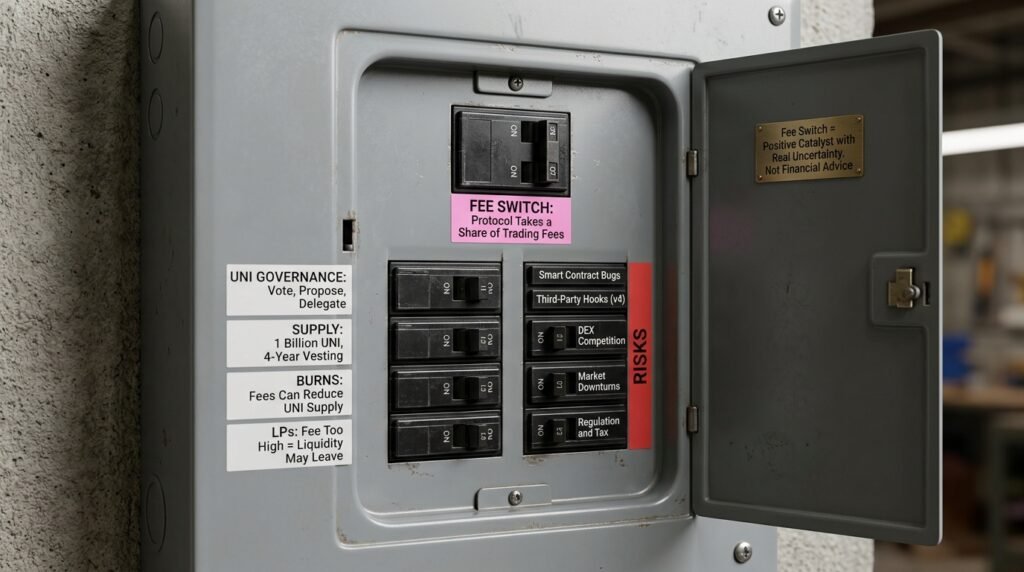
The fee switch is a protocol setting that lets Uniswap take a small share of the trading fees that LPs normally earn. For most of its life, the switch stayed off, so all fees went to liquidity providers and none reached the protocol. Governance debated turning it on for years, because it could finally link protocol revenue to the UNI token. Supporters argue that the switch would turn UNI into a value-accruing asset, similar to a share of a growing business. Governance moved this discussion.
forward with proposals that connected protocol fees to token burns, which would reduce supply over time. Readers should check the latest governance forum and official announcements for the exact parameters that went live. The design also matters because a fee that is too high could push LPs and traders toward cheaper competitors. Uniswap must balance token value against the health of its liquidity. Because of this, the fee switch is the most important factor in any Uniswap investment review today. It changes the core investment case from pure governance to a potential revenue model.
What the Fee Switch Could Mean for UNI Holders
If the protocol collects fees and uses them to burn UNI, token supply could shrink as trading volume grows. A shrinking supply with steady or rising demand often supports price, although no outcome is guaranteed. Analysts compare this model with stock buybacks, because both return value to holders when the business performs well. The result depends heavily on real trading volume, which rises and falls with market sentiment. In a weak market, fee income could drop sharply, and the burn effect would shrink with it. Competition also limits how high the protocol can set its take. If LPs earn less, they may move liquidity to other platforms, and volume could follow them. Regulation adds another layer, since authorities may treat fee-sharing tokens differently from pure governance tokens. Investors should therefore treat the fee switch as a positive catalyst with real uncertainty, not as a sure win. Track on-chain data to see how much value the mechanism actually captures.
Key Risks to Consider in a Uniswap Investment
Every investment in DeFi carries risks, and Uniswap is no exception despite its strong reputation. Smart contract bugs remain a constant threat because attackers target any protocol that holds large sums of value. Uniswap has audited its code many times, yet new features like hooks create fresh attack surfaces. Third-party hooks may contain errors that the core team does not control. Market risk also matters, since UNI trades with the broader crypto market and often falls hard in downturns. Competition is another real danger, as rival DEXs offer lower fees, incentives, or faster chains. Intent-based trading systems and aggregators could also reduce how much volume flows through Uniswap pools directly. Finally, the protocol depends on Ethereum and its layer-2 ecosystem, so network problems can hurt activity. Investors should size positions carefully and never invest money they cannot afford to lose.
Regulatory and Legal Risks
Regulation poses one of the biggest unknowns for Uniswap and for its token. Authorities in the United States and other regions continue to debate how to treat decentralized exchanges and their governance tokens. Uniswap Labs has already adjusted parts of its interface, such as restricting certain tokens, to reduce legal pressure. Enforcement actions against other crypto firms show that rules can change quickly. If regulators label UNI as a security after the fee switch begins, access on some exchanges could shrink. Taxation also affects both traders and LPs, because each swap and each fee claim can create a taxable event in many countries. Clear rules would help the industry, but the path toward clarity remains slow and uneven. Anyone who reads this Uniswap investment review should check local laws before they trade or provide liquidity. Professional tax and legal advice can prevent costly mistakes.
Long-Term Potential: Is UNI a Good Investment?
Uniswap offers a rare mix of strong adoption, deep liquidity, and an improving token model. The protocol has survived multiple bear markets and still attracts developers who build new products on top of it. If crypto trading volume continues to grow, a protocol that captures even a small fee could earn meaningful revenue. Upgrades like v4 and Unichain give Uniswap tools to defend its market share and expand into new areas. On the other hand, UNI’s price depends on market cycles, governance choices, and regulatory outcomes that no one can predict. Bulls see a blue-chip DeFi asset with a maturing business model. Bears see a competitive market where fee pressure and rivals could limit returns. A balanced investor might treat UNI as a long-term, higher-risk holding within a diversified portfolio. This article does not offer financial advice, so always research independently before you invest. Use official sources, on-chain data, and governance records to guide your final decision.
FAQs About Uniswap Investment Review
What is Uniswap used for?
Uniswap lets users swap crypto tokens directly from their wallets through smart contracts. It also lets people earn trading fees by providing liquidity to pools.
What does the Uniswap fee switch do?
The fee switch lets the protocol collect a share of trading fees instead of sending all fees to liquidity providers. Governance can use that revenue to support the UNI token, for example through burns.
Is UNI a good long-term investment?
UNI has strong adoption and a growing value model, but it also carries market, competition, and regulatory risks. Each investor should assess personal risk tolerance and research current data first.
What are the biggest risks of investing in Uniswap?
The main risks include smart contract bugs, strong DEX competition, market volatility, and unclear regulation. Hooks in v4 can also add risk when third parties build them poorly.
How can I buy UNI?
You can buy UNI on major centralized exchanges or swap for it on Uniswap with a compatible wallet. Always verify the official token contract address before you trade.
Conclusion: Uniswap Investment Review
Uniswap remains the leading name in decentralized trading, and the fee switch gives UNI a clearer path to value than it had before. Strong liquidity, a trusted brand, and technical upgrades like v4 and Unichain support the long-term case. Risks such as competition, smart contract flaws, and regulation still deserve serious attention. This Uniswap investment review shows that UNI suits investors who accept volatility and follow governance closely. Do your own research, diversify your holdings, and never rely on a single source. For more crypto analysis and market guides, visit coinindesk.com.
