

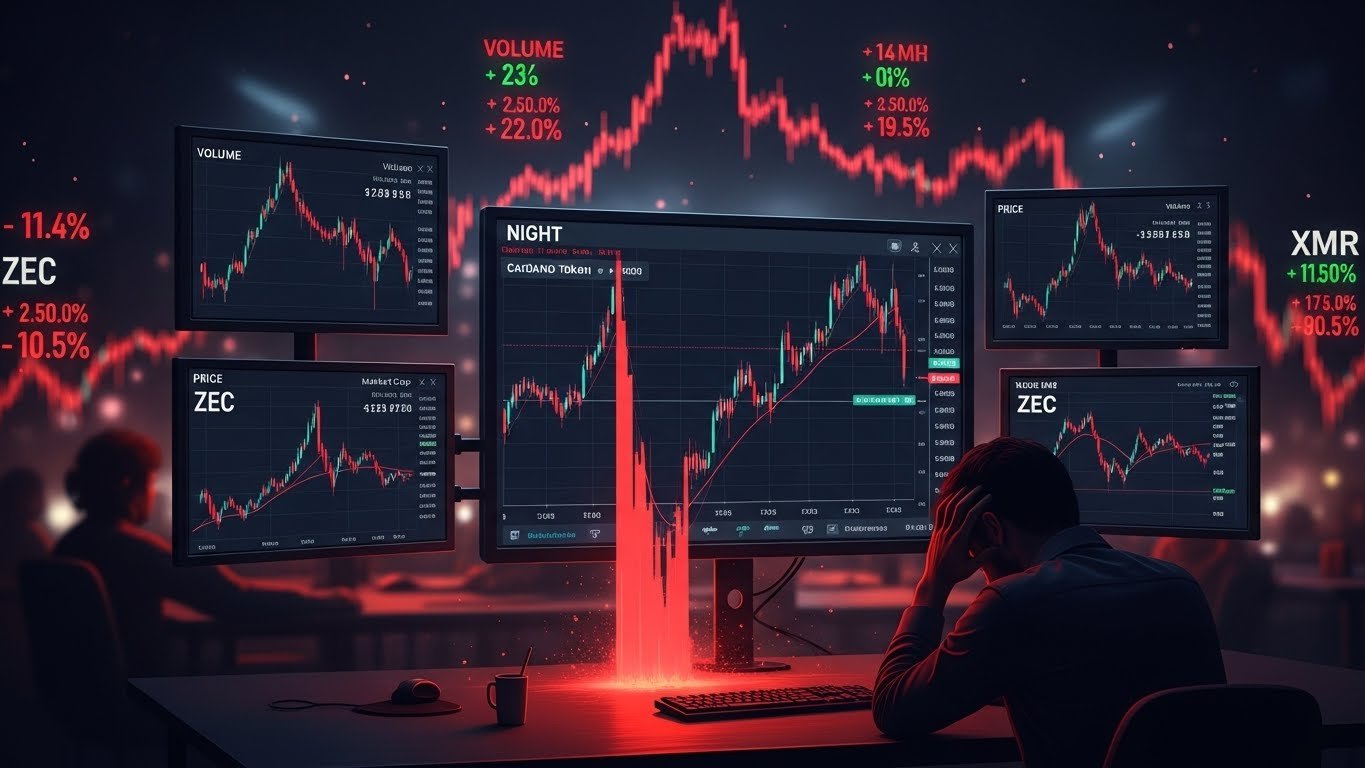
Crypto markets today are firmly in the red as selling pressure intensifies across multiple sectors of the digital asset space. The most dramatic move has come from Cardano-based NIGHT, which has suffered a sharp crash that erased weeks of gains in a short period of time. At the same time, established privacy-focused cryptocurrencies such as Zcash (ZEC) and Monero (XMR) have also declined, adding to the sense that risk appetite is fading across the board. This synchronized downturn has left traders cautious and investors reassessing their short-term outlook.
The broader context behind crypto markets today is one of fragile confidence. While long-term narratives around blockchain adoption and decentralized finance remain intact, short-term sentiment has turned defensive. Volatility has increased, liquidity has thinned, and even fundamentally strong projects are not immune to sudden sell-offs. The crash in NIGHT, combined with losses in ZEC and XMR, highlights how interconnected sentiment has become, where weakness in one segment can quickly spill over into others.
This article provides an in-depth look at crypto markets today, examining why NIGHT crashed so abruptly, why ZEC and XMR are also under pressure, and what these moves reveal about the current state of the market. By exploring technical, psychological, and macro-driven factors, we aim to offer clarity during a period of heightened uncertainty.
Crypto Markets Today Reflect Broad Risk-Off Sentiment
Crypto markets today are reflecting a clear shift toward risk-off behavior. Traders who were previously willing to speculate on emerging tokens and niche narratives are now prioritizing capital preservation. This shift has resulted in widespread selling across both large-cap and mid-cap cryptocurrencies.
Risk-off sentiment typically emerges when confidence weakens, and that appears to be the case now. Macroeconomic uncertainty, lingering regulatory questions, and repeated failed rallies have all contributed to caution. In such an environment, even isolated negative developments can trigger outsized reactions, accelerating declines.
The synchronized drop across assets like NIGHT, ZEC, and XMR suggests that this is not a project-specific issue alone. Instead, crypto markets today are being driven by collective sentiment, where fear and uncertainty are dictating short-term price action.
Cardano-Based NIGHT Crashes Amid Heavy Selling Pressure
The most eye-catching move in crypto markets today has been the sudden crash of Cardano-based NIGHT. The token, which had attracted attention for its integration within the Cardano ecosystem, experienced intense selling that overwhelmed buy-side demand. Prices fell rapidly, catching many traders off guard and triggering liquidations.
Several factors may have contributed to the NIGHT crash. Thin liquidity amplified the impact of large sell orders, while leveraged positions were forced to unwind as prices broke below key support levels. Once momentum turned negative, panic selling took over, accelerating the decline.
The NIGHT crash underscores a recurring theme in crypto markets today: smaller or newer assets are particularly vulnerable during periods of fear. When confidence dips, traders often exit higher-risk positions first, leading to sharp and sometimes disorderly moves.
The Role of Cardano Ecosystem Sentiment

NIGHT’s association with the Cardano ecosystem adds another layer to its decline. While Cardano itself remains one of the most actively developed blockchain networks, sentiment around ecosystem tokens can fluctuate significantly. When enthusiasm cools or attention shifts elsewhere, projects tied to a specific ecosystem may experience disproportionate volatility.
In crypto markets today, ecosystem-driven narratives are struggling to gain traction. Traders appear less interested in long-term potential and more focused on immediate risk. This environment makes it difficult for tokens like NIGHT to sustain momentum, especially when broader market sentiment is negative.
The crash has also prompted discussions about risk management within emerging ecosystems. Investors are being reminded that even promising projects can experience severe drawdowns during market-wide downturns.
ZEC Declines as Privacy Coins Face Renewed Pressure
Zcash (ZEC) has also dropped in crypto markets today, reflecting renewed pressure on privacy-focused cryptocurrencies. ZEC, long known for its emphasis on transaction privacy and cryptographic innovation, has struggled to attract consistent buying interest in recent weeks.
The decline in ZEC is partly sentiment-driven. Privacy coins often face additional scrutiny due to regulatory concerns, which can dampen investor enthusiasm during uncertain periods. When markets turn defensive, assets perceived as controversial or higher-risk tend to underperform.
Despite its technological strengths, ZEC has not been immune to these dynamics. Its drop today reinforces the idea that market sentiment can outweigh fundamentals in the short term, particularly when fear dominates trading behavior.
XMR Drops as Traders Reduce Exposure to Risk
Monero (XMR), another major privacy-focused cryptocurrency, has also fallen in crypto markets today. XMR has historically been more resilient than many altcoins due to its strong community and clear use case. However, even this resilience has limits during broad market downturns.
The XMR drop reflects traders reducing exposure across the board rather than reacting to project-specific news. In periods of heightened uncertainty, investors often streamline portfolios, exiting positions that may carry regulatory or liquidity risk.
The decline in XMR alongside ZEC highlights a broader trend affecting privacy coins. While their long-term relevance remains a topic of debate, short-term price action suggests that they are currently out of favor among risk-averse traders.
Technical Factors Amplifying the Downturn
Technical analysis plays a significant role in shaping crypto markets today. The breakdown of key support levels often triggers algorithmic selling and stop-loss orders, intensifying downward momentum. This dynamic appears to have been at play in the crashes and drops seen across NIGHT, ZEC, and XMR.
Once prices fall below widely watched technical thresholds, sentiment can deteriorate rapidly. Traders who rely on charts interpret these moves as confirmation of weakness, reinforcing bearish behavior. In thin markets, this effect becomes even more pronounced.
The current technical landscape suggests that crypto markets today are in a fragile state, where small shocks can lead to outsized reactions.
Liquidity Conditions and Market Fragility
Liquidity has become a central issue in crypto markets today. Reduced trading volumes mean fewer buyers are available to absorb selling pressure, making prices more sensitive to large orders. This fragility increases volatility and contributes to sharp intraday moves.
The NIGHT crash is a clear example of how liquidity constraints can exacerbate declines. As sellers rushed to exit, the lack of depth on the order book allowed prices to fall rapidly. Similar dynamics, though less extreme, have affected ZEC and XMR.
Persistent low liquidity also discourages participation, creating a self-reinforcing cycle. Until confidence improves and volumes recover, crypto markets today are likely to remain volatile and unstable.
Market Psychology and Fear-Driven Trading
Market psychology is a powerful force shaping crypto markets today. Fear-driven trading often leads to herd behavior, where individuals follow the actions of others rather than independent analysis. This can result in cascading sell-offs even in the absence of new information.
The visibility of NIGHT’s crash may have heightened anxiety, prompting traders to reassess risk across their portfolios. As fear spreads, selling pressure can jump from one asset to another, explaining why ZEC and XMR also declined.
Understanding this psychological component is essential for interpreting price movements. Crypto markets today are not solely reacting to fundamentals but to collective emotion.
Broader Altcoin Weakness and Sector Rotation
The declines seen today are part of a broader pattern of altcoin weakness. Many traders are rotating away from smaller or specialized tokens and into more liquid assets or stable positions. This rotation reflects a desire for safety rather than conviction in immediate upside.
Sector rotation often accelerates during downturns, leaving certain categories disproportionately affected. In crypto markets today, ecosystem tokens and privacy coins appear to be bearing the brunt of this shift. This behavior does not necessarily imply long-term rejection of these sectors, but it does highlight how quickly capital can move when sentiment changes.
Implications for Short-Term Traders
For short-term traders, crypto markets today present a challenging environment. Increased volatility and reduced liquidity make risk management more difficult. Sudden crashes like that of NIGHT can result in rapid losses, particularly for leveraged positions. Traders must adapt by reducing position sizes, tightening risk controls, and remaining alert to sentiment shifts. In fear-driven markets, patience and discipline become especially important. Understanding that current price action is heavily sentiment-driven can help traders avoid overreacting to short-term noise.
Long-Term Perspective Amid Current Weakness
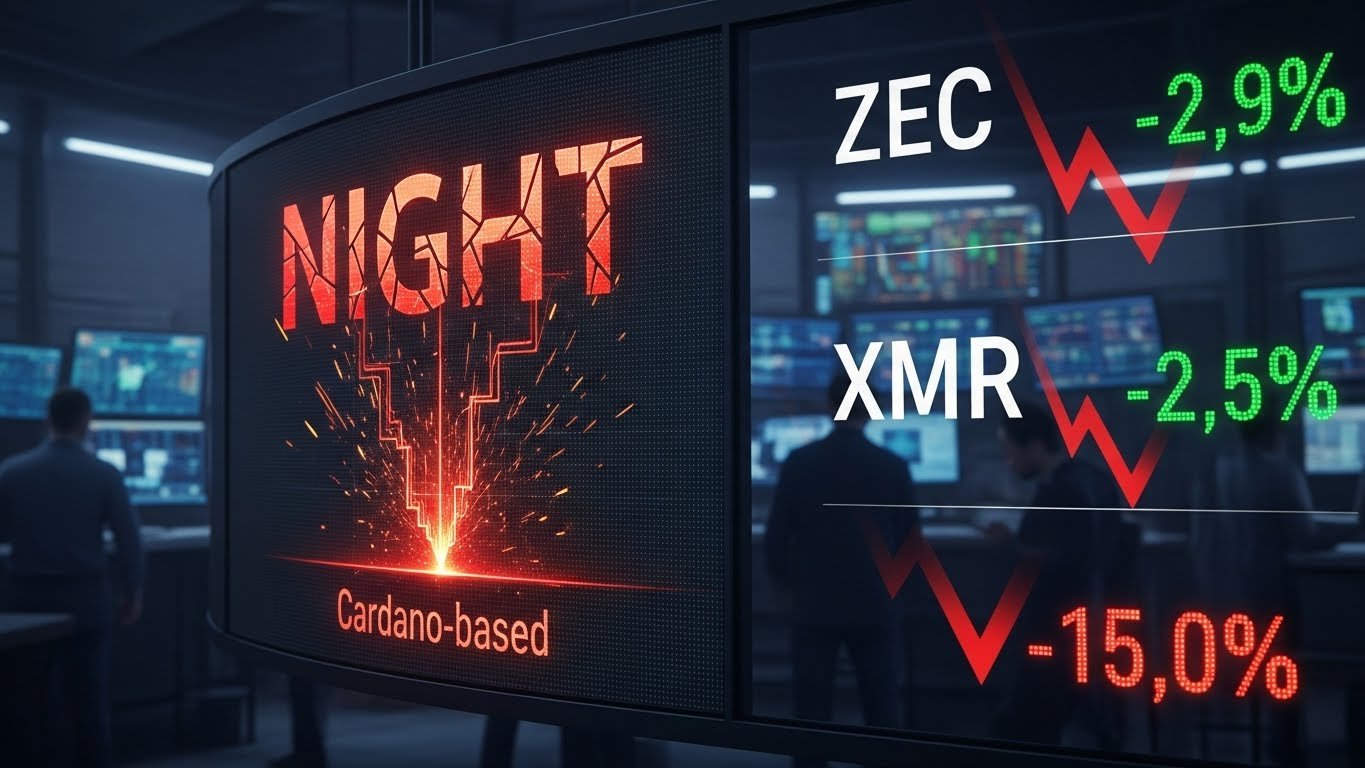
From a long-term perspective, the declines in crypto markets today may be viewed differently. Long-term investors often see periods of fear as part of the broader market cycle. While short-term price action can be unsettling, it does not necessarily undermine the fundamental case for blockchain technology.
However, long-term conviction is tested during sharp downturns. Investors must evaluate whether their original thesis remains valid and whether current prices reflect temporary sentiment or deeper issues. The NIGHT crash and drops in ZEC and XMR serve as reminders that volatility is inherent in crypto markets, requiring careful portfolio management and realistic expectations.
Conclusion
Crypto markets today are experiencing a clear downturn as Cardano-based NIGHT crashes and established privacy coins like ZEC and XMR also drop. This synchronized weakness reflects a broader shift toward risk-off sentiment, driven by fear, reduced liquidity, and fragile confidence. The sharp decline in NIGHT highlights the vulnerability of smaller ecosystem tokens, while losses in ZEC and XMR show that even well-known assets are not immune during market-wide sell-offs.
Understanding the forces behind these moves is essential for navigating the current environment. Crypto markets today are shaped as much by psychology and liquidity as by fundamentals. While uncertainty remains high, recognizing these dynamics can help traders and investors make more informed decisions during periods of heightened volatility.
FAQs
Q: Why did Cardano-based NIGHT crash so suddenly in crypto markets today?
The NIGHT crash was driven by heavy selling pressure, thin liquidity, and the breakdown of key support levels. Once prices started falling, panic selling and liquidations accelerated the decline.
Q: Why are ZEC and XMR also dropping alongside NIGHT?
ZEC and XMR are dropping due to broad risk-off sentiment in crypto markets today. Traders are reducing exposure across the board, and privacy coins often face additional pressure during fearful market conditions.
Q: Does the decline in privacy coins mean their long-term outlook is weakening?
Short-term declines do not necessarily reflect long-term fundamentals. The drops in ZEC and XMR are largely sentiment-driven, and their long-term relevance depends on adoption, regulation, and technological development.
Q: How should traders approach crypto markets today given the high volatility?
Traders should prioritize risk management by reducing position sizes, avoiding excessive leverage, and remaining cautious. Understanding that fear is driving price action can help prevent impulsive decisions.
Q: Can current weakness in crypto markets today create opportunities for long-term investors?
For long-term investors, periods of fear and sharp declines can present opportunities if the underlying projects remain fundamentally sound. However, careful evaluation and patience are essential before making decisions.
