


Illicit finance has a habit of evolving faster than the systems designed to stop it. Every major leap in financial technology—from wire transfers to online banking to instant payments—has offered new efficiencies to honest users and new opportunities to criminals. Blockchain is no different, except that it moves at software speed and across borders by default. That reality has pushed illicit blockchain activity tracking from a specialized niche into a front-line necessity for exchanges, payment providers, regulators, investigators, and cyber security teams.
On paper, blockchains are transparent. Transactions are recorded publicly, timestamped, and linkable through addresses. Many early observers assumed this would make crime difficult: if everything is on-chain, surely everything is traceable. The industry has since learned that visibility is not the same as understanding. Criminals don’t need to erase their footprints if they can bury them under complexity—splitting funds into dozens of paths, routing through bridges, swapping assets repeatedly, and hopping across multiple networks until the narrative becomes too expensive to reconstruct.
This is where the next generation of illicit blockchain activity tracking is headed: not just “can we trace,” but “can we trace quickly, across chains, with evidence investigators can act on, while avoiding an avalanche of false alarms?” That question sits at the heart of SynapTrack, an adaptive cross-chain anti–money laundering framework showcased at CyberASAP Demo Day by the University of Birmingham, with implementation support and practical blockchain constraints contributed by Nimiq.
SynapTrack matters because it represents a broader shift in how the industry approaches illicit blockchain activity tracking. The first wave of tooling leaned heavily on static rules and known typologies—useful, but brittle. The second wave introduced richer analytics and larger labeled datasets, but still struggled with cross-chain fragmentation and operational overload. What’s emerging now is a third wave: systems designed to learn, adapt, and prioritize, aligning detection with how modern laundering actually behaves and how compliance teams actually work.
In this article, we’ll unpack what SynapTrack signals about the future of illicit blockchain activity tracking, why cross-chain laundering has become the dominant challenge, how adaptive scoring approaches can cut false positives, and what organizations should watch as blockchain forensics becomes more automated and more integrated into mainstream cyber security.
Why illicit blockchain activity tracking is entering a new era
The crypto ecosystem has expanded beyond a handful of blockchains into a dense web of Layer 1 networks, Layer 2 scaling systems, application-specific chains, bridges, and decentralized exchanges. That growth has made digital asset markets more useful and more accessible. It has also created new hiding places for bad actors.
The traditional AML mindset is built around regulated intermediaries and relatively stable transaction rails. In many crypto pathways, intermediaries are minimal, transactions are fast, and the rails can change overnight. This pushes illicit blockchain activity tracking into a constant race against adversarial innovation. When criminals find a detection pattern, they don’t argue with it—they route around it.

At the same time, regulatory expectations are hardening. Crypto service providers face rising pressure to show robust AML compliance, demonstrate effective controls against sanctions exposure, and provide defensible audit trails. That pressure isn’t limited to “big” exchanges. Payment processors, custodians, on-ramps, off-ramps, and even certain DeFi-adjacent services increasingly face demands for proactive risk management. The result is that illicit blockchain activity tracking must become faster, more accurate, and more operationally realistic.
There is also a cyber security angle that’s easy to miss. Illicit flows don’t just fund fraud; they often connect to ransomware, extortion, data theft monetization, and other cyber-enabled crime. In that sense, stronger illicit blockchain activity tracking supports incident response. If a security team can trace where money moved after an intrusion, they gain intelligence about threat actor infrastructure, laundering routes, and potentially recoverable choke points.
CyberASAP Demo Day and why it matters for blockchain investigations
Research breakthroughs often die quietly between the lab and the market. They’re promising, but not packaged. They solve a real problem, but not in a way that fits procurement cycles, integration realities, and day-to-day workflows. CyberASAP Demo Day exists to close that gap by helping academic teams take cyber security innovations from research into commercialization pathways.
SynapTrack’s presence at CyberASAP signals that cross-chain AML is being treated as a core cyber security challenge rather than a niche compliance feature. That framing is important. It encourages collaboration between disciplines that historically worked in parallel: cryptography and distributed systems, machine learning, cyber defense, and financial crime prevention. The future of illicit blockchain activity tracking will almost certainly be interdisciplinary, because the problem itself sits at the intersection of technology, behavior, and regulation.
It also emphasizes “demo day” realism. A demo is not a paper. When a system is presented for potential partners, customers, and evaluators, it must explain what it does, how it fits into existing operations, and why it is better than what already exists. That market-oriented pressure tends to favor practical innovation—especially for illicit blockchain activity tracking, where usability can matter as much as raw technical capability.
The cross-chain problem: where illicit blockchain activity tracking breaks down
Single-chain tracing is difficult; cross-chain tracing is a different category of problem. Many investigative methods were built for a world where value mostly stayed within one ledger. In that world, transaction graph analysis could map flows, cluster addresses, and identify suspicious patterns inside a coherent network.
Cross-chain laundering breaks that coherence. Value can move via bridges, wrapped tokens, liquidity pools, and off-chain coordination that results in on-chain effects. Funds can split, swap, and reappear on another network in ways that are not always one-to-one. Even when the bridge event itself is visible, the contextual meaning of that event can be hard to interpret without a cross-network model of behavior.
This fragmentation creates two common failure modes for illicit blockchain activity tracking. The first is blind spots: a tool can follow the trail on one chain but loses it at the boundary. The second is noise: tools compensate by flagging many boundary-crossing events as suspicious, increasing false positives and burning analyst time.
To move beyond these failure modes, the next era of illicit blockchain activity tracking needs systems that treat cross-chain movement as normal—and suspicious only in context—while still enabling investigators to rebuild narratives across multiple networks.
SynapTrack at a glance: what was showcased
SynapTrack was showcased as an advanced detection system designed to identify and trace blockchain funds connected to criminal activity, with a focus on cross-chain laundering behavior. It is positioned as a framework that aims to trace illicit flows faster and more accurately while reducing false positives—an especially important goal for compliance teams working under time pressure and limited analyst capacity.
The details that matter most are not marketing phrases like “AI-powered,” but the operational promises behind them: risk scoring instead of rigid binaries, dynamic adaptation to evolving laundering tactics, and cross-chain capability aligned to real-world laundering routes. These are the features that tend to define whether illicit blockchain activity tracking is usable in production.
A focus on fewer false positives, not just more detection
A major pain point in compliance is that many tools detect “unusual” activity but produce overwhelming volumes of alerts. If every complicated transaction triggers a warning, analysts spend their days clearing noise instead of finding meaningful leads. Over time, alert fatigue becomes its own risk—teams may miss the signals that matter most.
SynapTrack is described as designed to cut false positives substantially while maintaining high tracing accuracy. For the future of illicit blockchain activity tracking, that focus is crucial. The goal is not to detect everything; it is to detect the right things in a way that supports action.
In practice, reducing false positives can have compounding benefits. It shortens investigation queues, speeds up escalation where needed, improves the quality of suspicious activity reports, and increases confidence in the system’s outputs. It also builds healthier collaboration between compliance and product teams, because fewer false positives means fewer unnecessary account freezes and fewer disruptive customer experiences.
Tested against real-world laundering activity
A recurring weakness of academic prototypes is that they are validated on clean datasets that don’t reflect real-world messiness. A system’s credibility grows when it is tested on real incident patterns. SynapTrack has been described as tested against real-world laundering activity connected to a major exchange hack scenario, emphasizing both high tracing accuracy and very low false positives.
That matters because illicit blockchain activity tracking is inherently adversarial. Criminals adjust tactics when detection improves. Validation against real activity doesn’t guarantee future success, but it indicates the system is designed with practical laundering behavior in mind rather than idealized assumptions.
The Nimiq–University of Birmingham collaboration: why it’s a strong model
The story behind SynapTrack highlights an important trend: the most effective illicit blockchain activity tracking systems are built by teams that combine research depth with real-world engineering constraints.
Universities contribute rigorous methodology, careful evaluation, and conceptual breakthroughs that may not emerge from product teams under short-term delivery pressure. Blockchain teams contribute implementation realism: performance constraints, network quirks, developer experience, and the messy details of how systems behave in the wild. When these perspectives are combined early, the result is more likely to be both accurate and deployable.
This matters because cross-chain AML is not solved by one clever model. It requires robust ingestion pipelines, consistent abstractions across chains, explainable outputs, and a product surface that fits into compliance workflows. The future of illicit blockchain activity tracking will be shaped by collaborations that can handle that full stack: algorithm, data, and operations.
How SynapTrack approaches illicit blockchain activity tracking
While implementation specifics can vary, the approach described for SynapTrack aligns with where the field is moving: probabilistic scoring, adaptive learning, and cross-chain tracing designed to preserve narrative continuity.
Scoring laundering likelihood instead of binary labeling
Many older systems implicitly treat detection as binary: suspicious or not suspicious. In reality, investigations rarely work like that. Evidence accumulates. Patterns become clearer when multiple signals converge. A scoring approach can reflect uncertainty while still supporting decision-making.
SynapTrack is described as using a methodology that scores the likelihood a transaction is part of a laundering scheme. For illicit blockchain activity tracking, this is a practical evolution. A risk score enables triage: investigators can focus on the top fraction of cases where the probability and potential impact are highest.
A scoring approach can also support explainability. When a system ranks risk, it can attach contributing factors—such as unusual cross-chain routing, rapid multi-hop swaps, clustering behavior consistent with layering, or timing patterns that match known laundering tactics. Even without exposing sensitive detection logic, providing interpretable reasoning improves trust and usability.
Self-improving detection that keeps pace with adversaries
A central challenge in illicit blockchain activity tracking is that laundering tactics evolve. Criminals learn from enforcement actions, public research, and even compliance leaks. They adjust their patterns to avoid detection rules. A self-improving system is designed to adapt continuously rather than relying on static patterns. In principle, this means the model can recognize emerging laundering behaviors earlier and reduce the time window where criminals can exploit a new technique before detection catches up.
This approach also fits how modern cyber security tooling works. In areas like malware detection and phishing prevention, static rules have been replaced by systems that update frequently and learn from new samples. Illicit blockchain activity tracking is moving toward that same model: continuous learning, continuous tuning, and faster iteration cycles.
Cross-chain capability aligned to real laundering routes
Cross-chain laundering is not just “bridge once.” Real laundering can involve multiple bridge hops, swaps into different assets, splitting across chains, and rejoining downstream. Tracking this behavior requires maintaining continuity in the transaction graph across network boundaries. SynapTrack is positioned as having universal cross-chain capability, designed specifically for cases where existing systems struggle. The broader implication is clear: the future of illicit blockchain activity tracking will depend on tools that treat cross-chain tracing as a core function, not an add-on.
Why workflow design is central to illicit blockchain activity tracking
Even the most accurate detection model can fail operationally if it doesn’t fit into real workflows. Compliance and investigations teams are not trying to admire graphs; they are trying to resolve cases. That process usually includes alert intake, triage, evidence gathering, escalation, documentation, and sometimes external reporting.
SynapTrack is described as presenting results in a dashboard, with a design goal of requiring no major infrastructure changes to deploy. This emphasis reflects a growing truth: illicit blockchain activity tracking must be as much about usability and integration as about algorithms.
When dashboards align with investigative thinking, they accelerate action. They can show the story of funds rather than isolated events. They can highlight the most informative links in a transaction chain. They can support case notes and handoffs between teams. They can prioritize by risk and potential impact. Most importantly, they can reduce the time it takes to move from “something might be wrong” to “here is what happened and what we should do next.”
In the future, the strongest illicit blockchain activity tracking platforms will likely offer both a human-facing interface and an API layer that can integrate with case management systems, sanctions screening tools, fraud platforms, and internal data sources. This is how detection becomes an operational capability rather than a standalone analytics product.
Who benefits most from next-generation illicit blockchain activity tracking
As blockchain becomes a shared layer for finance-like activity, the set of stakeholders expands. The organizations that benefit most from improved illicit blockchain activity tracking are those that face both transaction risk and accountability pressure. Centralized exchanges and custodians need cross-chain visibility to manage deposit and withdrawal risk, detect suspicious flows, and protect customers. Payment processors and on-ramps need robust monitoring to prevent fraud and satisfy banking partners.
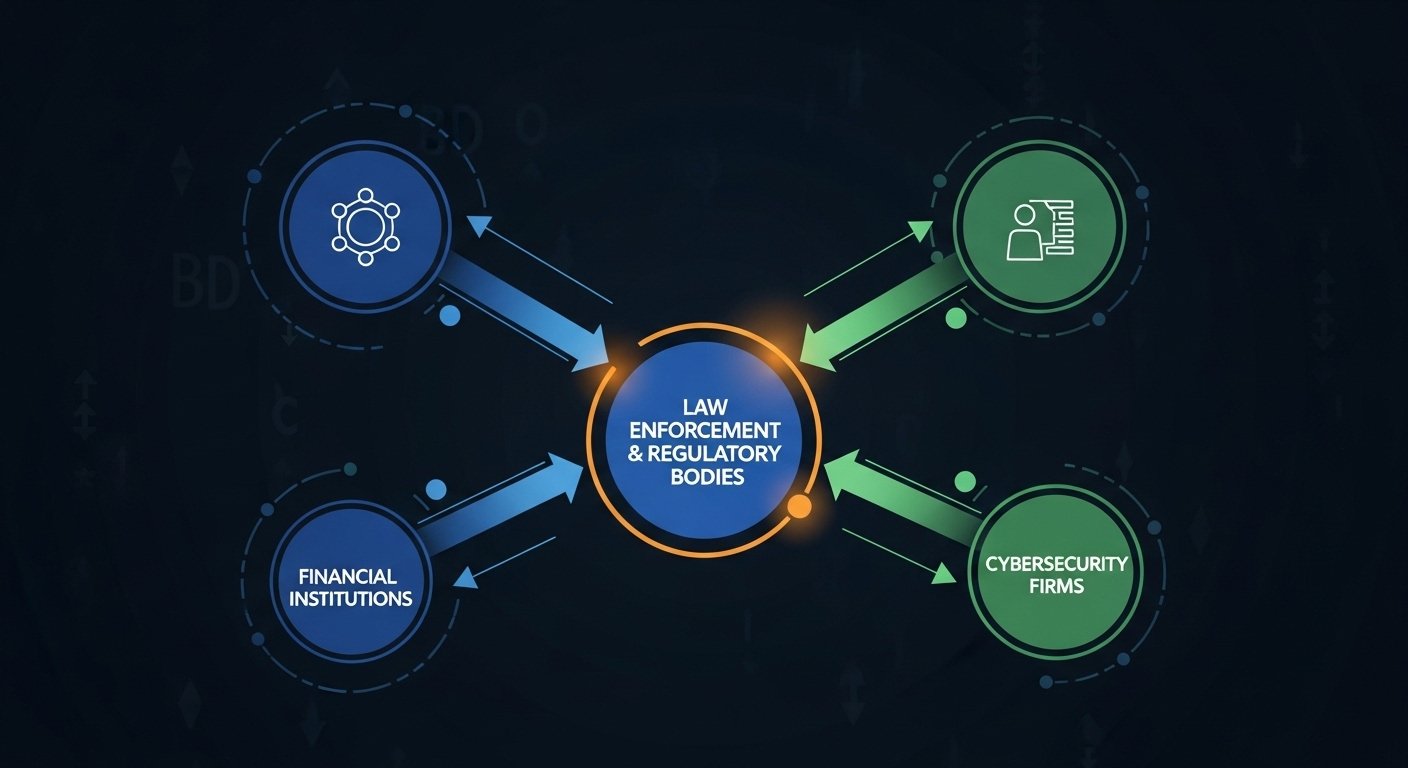
DeFi platforms and ecosystem participants need better threat intelligence to understand how illicit flows interact with open liquidity and composable protocols. Regulators and law enforcement need prioritization and narrative reconstruction to focus scarce resources on the most impactful cases. What ties these stakeholders together is a need for evidence-driven decisions. Illicit blockchain activity tracking is not only about catching criminals; it is also about avoiding harm to legitimate users by reducing unnecessary freezes and avoiding overreaction to ambiguous patterns.
The broader trend: from static rules to adaptive, evidence-driven tracing
SynapTrack points to several trends that are likely to define the future of illicit blockchain activity tracking. Cross-chain tracing is becoming the baseline expectation. As ecosystems fragment and bridge usage increases, single-chain visibility will be insufficient for serious compliance and investigations. False positives are becoming the defining performance metric. A system that overwhelms analysts can reduce security in practice by slowing investigations and increasing fatigue. The field is shifting toward precision and prioritization. Adaptability is becoming the differentiator. Criminals evolve. Static typologies degrade. Self-improving systems, frequent updates, and feedback-driven learning loops will increasingly shape competitive advantage.
Workflow integration is becoming the path to adoption. Dashboards, APIs, explainability, and operational packaging determine whether detection becomes action. The future of illicit blockchain activity tracking will be won by tools that make investigators faster and more confident, not just tools that produce sophisticated charts. Finally, collaboration is becoming essential. No single team sees the whole picture across chains, jurisdictions, and threat patterns. Systems that can incorporate feedback from developers, researchers, and practitioners will likely evolve faster and stay relevant longer.
Conclusion
The future of illicit blockchain activity tracking is moving toward systems that can follow value across chains, adapt to evolving laundering tactics, and reduce the noise that slows down human investigators. SynapTrack, showcased by the University of Birmingham with support from Nimiq at CyberASAP Demo Day, reflects that direction through its emphasis on cross-chain capability, adaptive scoring, and lower false positives.
As regulation intensifies and blockchain infrastructure becomes more interconnected, the real challenge is not whether tracing is possible. The challenge is whether tracing is fast, accurate, explainable, and operationally usable. The next generation of illicit blockchain activity tracking will be judged by outcomes: fewer missed cases, fewer wasted investigations, faster response times, and clearer narratives that support enforcement and compliance. SynapTrack is a compelling snapshot of that future—and a reminder that the winning tools will be the ones that help people act, not just observe.
FAQs
Q: What is illicit blockchain activity tracking in simple terms?
Illicit blockchain activity tracking is the process of analyzing blockchain transactions to identify, trace, and understand fund flows connected to crime, such as laundering, fraud, ransomware payments, and sanctions evasion.
Q: Why does cross-chain activity make illicit blockchain activity tracking harder?
Cross-chain movement can break the continuity of transaction graph analysis because value moves between networks with different structures and mechanisms. Bridges, swaps, and multi-hop routing can obscure the narrative and increase false positives if tools lack cross-chain context.
Q: How can lower false positives improve AML compliance outcomes?
Lower false positives reduce investigation backlogs, prevent alert fatigue, and help analysts focus on the most meaningful cases. In AML compliance, this improves response time, reporting quality, and overall risk management without unnecessarily disrupting legitimate users.
Q: What does “adaptive” mean for illicit blockchain activity tracking tools?
Adaptive systems are designed to update and learn as laundering tactics change. Instead of relying only on static rules, adaptive illicit blockchain activity tracking aims to recognize emerging patterns and reduce the time criminals can exploit new techniques.
Q: Who should pay attention to SynapTrack-style approaches?
Exchanges, custodians, payment processors, investigators, cyber security teams, and regulators all benefit from stronger cross-chain monitoring. Any organization exposed to crypto transaction risk can gain from illicit blockchain activity tracking that is more precise, more scalable, and better aligned to real workflows.
