


Blockchain governance has always carried a paradox at its core. On one hand, blockchains promise decentralization, immutability, and systems that cannot be altered by any single party. On the other hand, real-world blockchains operate in an environment where users can lose millions in minutes, where bridges can be exploited, and where the ecosystem often demands rapid emergency action. That tension—between “code is law” and “people must respond”—defines the future of blockchain governance more than any theoretical debate.
The Flow hack incident has become a defining moment for this conversation in late 2025. Reports describe a suspected exploit around $3.9 million to $4 million, which triggered emergency responses, exchange freezes, and a controversial remediation plan that included the idea of a chain rollback and full restart. This wasn’t just a security story. It was a governance story, because the choices made during the incident exposed how power is distributed in a blockchain network, how quickly coordination can happen, and what happens to trust when “immutability” becomes negotiable.
Even more importantly, the Flow hack incident raised a question every blockchain ecosystem must confront as the industry matures: when an attack happens, who gets to decide what the chain does next? Is the solution a rollback, a fork, a restart, a reimbursement plan, or a “hands-off” approach that preserves immutability even if users lose funds? The Flow situation shows that the answer is rarely simple. Partners and validators reportedly pushed back against rollback plans, and some voices urged validators to halt operations until clarity and remediation plans were properly defined.
This article explains what the Flow hack incident reveals about governance, security, validator influence, crisis response, and the direction blockchain networks are heading. It also explores what future blockchain governance must become if networks want to balance decentralization with real-world accountability.
Why Blockchain Governance Matters More Than Ever
In the early days, many blockchains treated governance as an afterthought. The focus was on building infrastructure, attracting developers, and proving that decentralized networks could function at all. But as blockchain adoption expanded, governance became a frontline issue because the stakes increased. When billions of dollars in value and mission-critical applications run on-chain, governance is no longer philosophical—it’s operational.
Blockchain governance is essentially the system that determines how decisions are made, how upgrades occur, how disputes are handled, and how emergencies are resolved. It includes validator incentives, protocol rules, community voting, foundation influence, and the social layer of coordination among exchanges, wallets, and major ecosystem partners.
The Flow hack incident illustrates why governance is now inseparable from security. A chain can have strong cryptography and still fail if its governance framework can’t respond to attacks quickly and credibly. Conversely, a chain can respond quickly but still lose trust if the response appears centralized, inconsistent, or unfair.
The Flow Hack Incident: What Happened and Why It Became a Governance Flashpoint
Reports published in late December 2025 describe a suspected security incident affecting Flow’s mainnet, accompanied by sharp market reaction and emergency measures by exchanges, including deposit and withdrawal halts by some platforms. The numbers cited in coverage clustered around a multi-million-dollar exploit, with $3.9 million referenced as a key figure in the incident narrative.
What turned this into a governance flashpoint was not only the exploit itself but the recovery approach. Coverage described a controversial rollback plan and network restart discussions, which drew criticism and concern from parts of the ecosystem, including partners and validator-aligned voices. The idea that a network could revert state after an exploit is the exact kind of scenario that tests what decentralization truly means.
In theory, many users assume blockchains are immutable. In practice, immutability depends on social consensus and the willingness of network participants to accept or reject changes. When governance mechanisms are unclear, emergency actions become messy, and trust becomes fragile. That is why the Flow hack incident is now being discussed as a case study in the future of blockchain governance.
What the Rollback Debate Reveals About Decentralization
A rollback is one of the most controversial actions a blockchain can consider. It typically means reverting the network state to a point before malicious transactions occurred, effectively undoing blocks or rewriting history. Even if the intent is to protect users, rollbacks raise immediate concerns about precedent, fairness, and the power to alter the ledger.
The Flow hack incident drew attention because rollback discussions surfaced publicly, leading to pushback from partners and concerns about risks to user trust and ecosystem stability. Critics of rollbacks argue that once a chain proves it can be rolled back, the blockchain becomes politically mutable. The question becomes: if history can be rewritten for one exploit, could it be rewritten for other reasons? Supporters of rollbacks argue that users deserve protection and that governance must be pragmatic, especially when the exploit threatens critical infrastructure like bridges and major user funds.
This debate highlights a key evolution in blockchain governance. The future likely won’t be defined by absolute immutability or absolute central control, but by formalized emergency governance structures with transparent procedures, clear thresholds, and strong legitimacy.
Validators, Foundations, and Power: Who Actually Governs in a Crisis?
One of the clearest lessons from the Flow hack incident is that governance power is not distributed evenly, especially in emergencies. Even in decentralized networks, certain actors hold disproportionate influence, including core developers, foundations, major validators, infrastructure providers, and large ecosystem partners.
During the rollback discussion, some reports noted calls for validators to stop processing transactions until remediation plans were issued and impacts were addressed. That dynamic reveals something important: validators are not passive participants. They can become a governance force by choosing whether to run software updates, accept rollback plans, or refuse to process blocks.
The Flow Foundation’s involvement, as described in coverage discussing investigation and recovery steps, underscores another reality: many networks still rely on foundation-led coordination during crisis moments. The question for the future of blockchain governance is not whether foundations will exist, but how their powers are limited, how they coordinate transparently, and how they maintain legitimacy.
The Bridge Factor: Why Cross-Chain Systems Increase Governance Risk
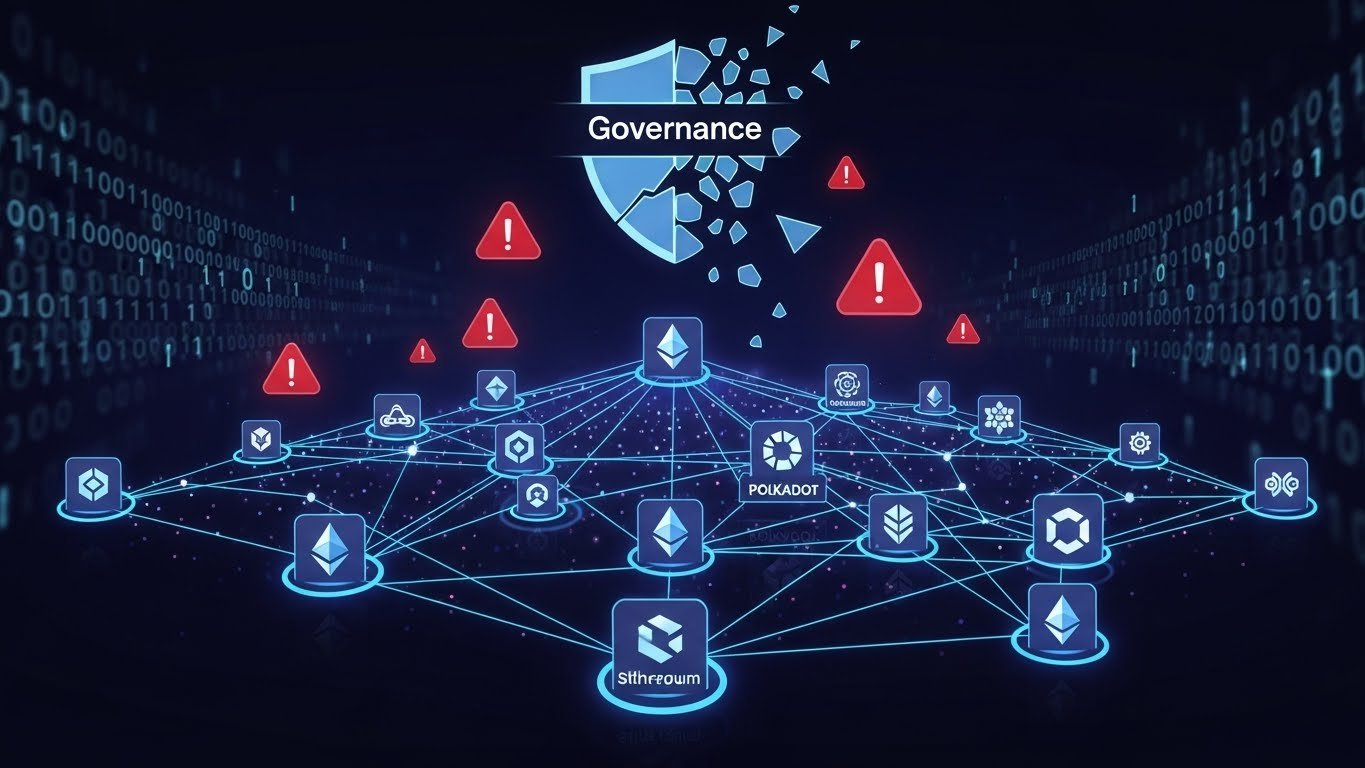
While details about the Flow incident have been discussed in various contexts, the broader theme of bridge vulnerability is deeply relevant. Cross-chain bridges remain one of the most exploited components of the crypto ecosystem, largely because they introduce complex trust assumptions and critical attack surfaces.
Security research and industry guidance consistently highlight that when bridge contracts are compromised, rapid action is required: pausing relayers, halting deposits and withdrawals, and coordinating quickly with partners and exchanges. This is where governance and security collide. The more interconnected a blockchain becomes—through bridges, wrapped assets, and cross-chain liquidity—the more a single exploit can ripple into the broader ecosystem, increasing the pressure for fast governance decisions. In practical terms, bridges force networks to develop “emergency governance” capabilities that are not optional. Without them, a bridge exploit can escalate into systemic damage affecting multiple ecosystems and partners.
Incident Response as Governance: The New Standard for Blockchain Networks
In traditional cybersecurity, incident response is a defined discipline with playbooks, escalation paths, and communication protocols. In blockchain, incident response becomes governance because responding to an exploit often involves protocol-level actions that affect all users.
Industry guidance emphasizes that on-chain incidents can lead to irreversible transfers within minutes, making speed and coordination essential. The Flow hack incident demonstrates how quickly market confidence can shift and how operational decisions can become politically charged. The future of blockchain governance will likely include formalized incident response frameworks, including predefined emergency powers, clear accountability structures, and transparent disclosure standards. Networks that treat incident response as an ad hoc activity will continue to experience governance crises during hacks.
Trust, Immutability, and User Expectations After the Flow Hack Incident
The Flow hack incident also underscores how user expectations are evolving. Many users want decentralization in theory, but they also want protection, refunds, and reliable infrastructure in practice. This creates conflicting pressures: the community demands that chains be unstoppable and immutable, yet also demands that someone do something when funds are stolen. When rollback plans appear, users split into camps. Some see it as necessary protection, others see it as proof the chain is not truly decentralized. Partners may worry about reputational risk and operational uncertainty. Validators may worry about precedent and liability. This is why governance must become more structured.
The future of blockchain governance depends on aligning user expectations with actual network capabilities. If a chain can rollback, it must explain under what conditions and how decisions are made. If a chain cannot rollback, it must explain what protections exist and how losses are handled. Silence or improvisation destroys trust faster than any exploit.
The Economic Layer: Token Price, Liquidity, and Governance Feedback Loops
Governance decisions don’t occur in a vacuum. They directly influence token price, liquidity, and exchange behavior. Reports around the Flow incident noted significant market impact, with dramatic token price movement following the suspected exploit. That’s not surprising: when governance is uncertain, capital exits quickly.
This creates a feedback loop where price volatility increases the urgency of governance response, and the urgency increases the risk of rushed, controversial decisions. In turn, controversial governance actions can deepen uncertainty and fuel further volatility. In the future, strong governance will be valued as a form of economic stability. Networks with predictable crisis procedures will likely see less extreme market reactions during incidents because investors can model outcomes more confidently.
Governance Design Lessons: What the Flow Hack Incident Teaches the Industry
The Flow hack incident provides several governance lessons that apply to most Layer 1 networks and ecosystem foundations. First, emergency governance must be predesigned, not improvised. Whether a network allows rollbacks, forks, or compensation mechanisms, the procedures should be defined long before an attack happens.
Second, validator alignment is essential. If validators do not trust the foundation’s plan or feel excluded from decision-making, consensus can fracture quickly. The reported call for validators to halt work illustrates how quickly governance can become conflict-driven. Third, communication must be clear and fast. Rumors and uncertainty spread rapidly during hacks, especially on social media. Transparent updates reduce panic and prevent misinformation from shaping the narrative.
Fourth, partner coordination must be considered part of governance. Exchanges, wallets, bridges, and infrastructure providers are deeply embedded in blockchain functioning. Their reaction can either stabilize the ecosystem or amplify disruption. Finally, governance must balance fairness with pragmatism. If remediation actions are perceived to favor certain groups or rewrite history selectively, trust can collapse.
The Future of Blockchain Governance: Toward Structured Emergency Powers

The long-term answer is not “always rollback” or “never rollback.” The future of blockchain governance likely involves structured emergency powers with strict limits. Governance research and community frameworks increasingly recognize the value of rollback or emergency reversal mechanisms in specific contexts, such as reversing executed proposals or mitigating catastrophic damage, but only when roles and procedures are clearly separated and auditable.
In the Flow hack incident context, the controversy around rollback proposals highlights why such mechanisms must be designed with legitimacy. Emergency powers should have defined triggers, transparent voting or approval structures, time locks where appropriate, and clear documentation of impacts. Most importantly, networks must decide what “irreversible” means in practice.
Some chains may move toward governance models where emergency actions are possible but require broad validator consensus and independent review. Others may prefer immutable principles but build stronger insurance and compensation frameworks instead. Either way, the industry is moving toward governance maturity, where crisis response is treated as a core feature, not an exception.
Security and Governance Convergence: A New Era After 2025
Across the broader industry, 2024 and 2025 have reinforced that hacks are frequent and that governance responses shape outcomes. Security reviews have highlighted that hack frequency remains high, and the ecosystem must adapt by building stronger security and response systems.
This is where blockchain governance is heading: a convergence between protocol design, security engineering, and social legitimacy. The Flow hack incident is not just a lesson about one network. It’s a signal that every chain must build governance that can handle emergencies without sacrificing the values that make blockchains meaningful in the first place.
Conclusion
Navigating the future of blockchain governance requires looking beyond ideals and focusing on real-world stress tests. The Flow hack incident became such a stress test because it combined a multi-million-dollar exploit with the most politically sensitive governance question possible: should a blockchain roll back history to undo a hack? Reports describing the suspected exploit, the network response, and the backlash to rollback plans show how quickly governance becomes the true battlefield during security incidents.
The biggest takeaway is that blockchain governance is entering a new era. It must become more formal, more transparent, and more resilient. Validators, foundations, partners, and users need clear rules for emergency actions, defined accountability structures, and communication standards that can withstand crisis pressure. Whether networks choose rollback-capable frameworks or strict immutability with compensation mechanisms, the future belongs to chains that can manage crises without losing legitimacy.
The Flow hack incident will be remembered not only for the exploit itself, but for what it revealed: decentralization is not a slogan, it’s a system of decision-making under pressure. And the chains that master that system will shape the next decade of blockchain adoption.
FAQs
Q: How did the Flow hack incident change the conversation about blockchain governance and decentralization?
The Flow hack incident changed the conversation because it exposed the real-world limits of “immutability” during high-stakes emergencies. When an exploit occurs and millions are at risk, communities demand immediate action, but the actions available—especially rollback proposals—raise fundamental questions about who controls the ledger. The debate around remediation and validator responses showed that decentralization is not only about technology but also about legitimacy, coordination, and stakeholder alignment. It highlighted that governance frameworks must be prepared in advance, because improvisation during a crisis can damage trust as much as the exploit itself.
Q: Why is a rollback considered controversial in blockchain governance, and what risks does it create for future incidents?
A rollback is controversial because it rewrites blockchain history, undermining the principle that transactions are final and immutable. Even if a rollback protects users in the short term, it sets a precedent that the chain can be altered under certain conditions. This creates risks such as politicization of ledger changes, disputes over which losses deserve reversal, and reduced confidence among institutions who rely on predictable settlement. In future incidents, communities could demand rollbacks more often, and attackers might even exploit governance uncertainty by creating scenarios that trigger chaotic decision-making.
Q: What role do validators play during governance crises like the Flow hack incident, and why does their behavior matter?
Validators are central because they operate the network’s consensus infrastructure and ultimately decide which software version they run and which chain state they accept. During governance crises, validators can become a counterbalance to foundations and development teams by refusing proposals they consider unsafe or illegitimate. Their behavior matters because it determines whether a network can coordinate effectively in emergencies or whether it fragments into conflict. The Flow incident illustrates that validator confidence and clear remediation plans are essential for maintaining continuity, because governance depends on operational participation, not just community opinion.
Q: How do bridge-related exploits increase the governance pressure on blockchains compared to isolated smart contract hacks?
Bridge exploits increase governance pressure because bridges are connective infrastructure that often affects multiple chains, exchanges, and asset ecosystems simultaneously. A bridge failure can trigger systemic risk, causing assets to lose backing, liquidity to destabilize, and partners to freeze activity quickly. This forces governance decisions to happen under extreme time pressure, often involving coordination beyond the chain itself. Because bridge incidents can spread fast and affect many stakeholders, they amplify the tension between swift action and preserving decentralization principles, making governance readiness even more critical.
Q: What does the Flow hack incident suggest about the future of blockchain governance design for Layer 1 networks?
The Flow hack incident suggests that Layer 1 networks will increasingly adopt structured emergency governance systems rather than relying on informal crisis coordination. Future governance design is likely to include predefined incident response playbooks, clearly limited emergency powers, transparent thresholds for extraordinary actions, and improved communication standards. Some networks may implement rollback-like mechanisms with strict controls, while others may reinforce immutability and invest more heavily in insurance, compensation frameworks, and security hardening. In every case, the lesson is that governance must be engineered with the same seriousness as protocol security because the two are now inseparable.
