

Zcash’s future scope depends on one big question: can a privacy coin keep growing while regulators and exchanges push back? ZEC has surged since 2025, but it has also faced sharp crashes, leadership drama, and regional delistings. Supporters say optional privacy gives Zcash a smarter path than fully hidden coins, while critics warn that tougher anti-money-laundering rules will squeeze every privacy asset. In this guide, we explain how Zcash works, how regulation and delistings affect it, what demand looks like, and which scenarios could shape the next few years. We also cover the main risks, so you can judge the coin with clear eyes.
What Is Zcash (ZEC)?
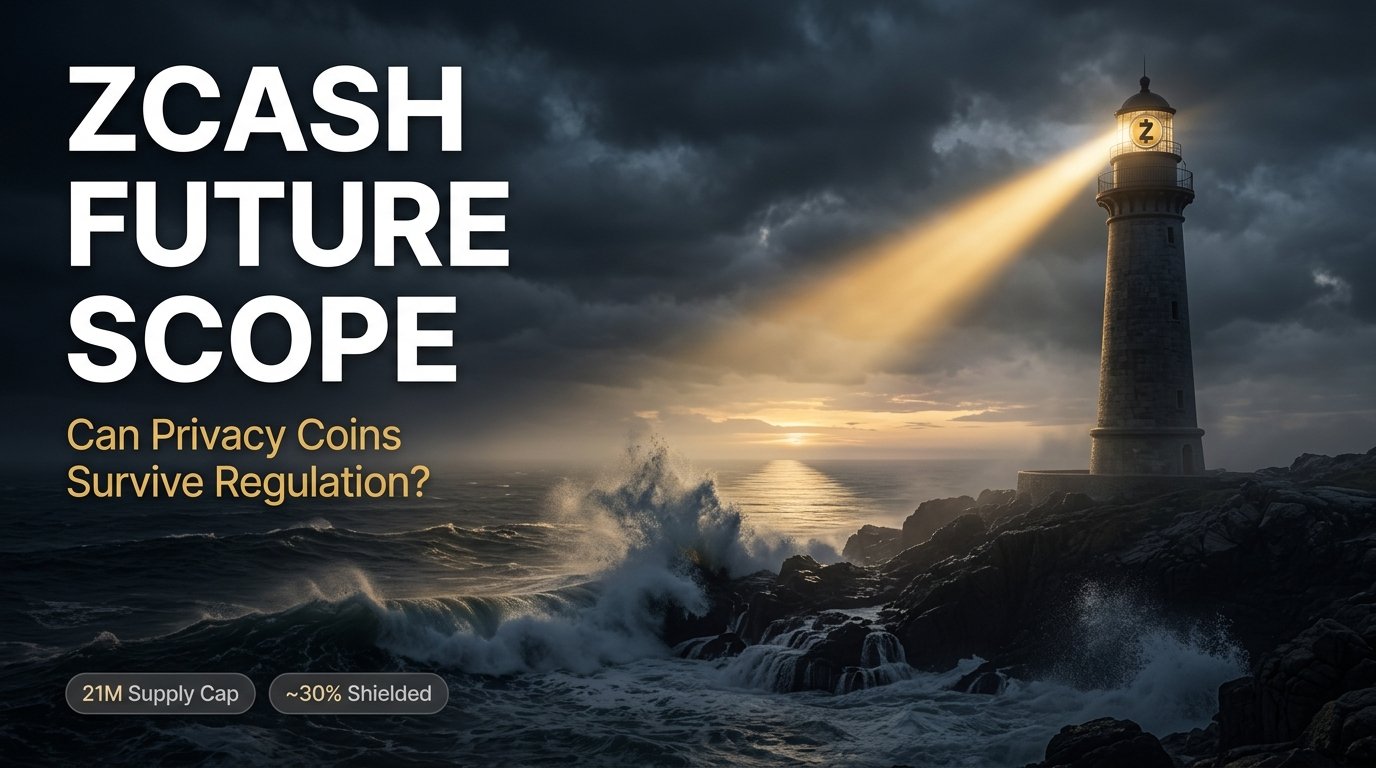
Zcash launched in 2016 as a project built on Bitcoin’s code with a major privacy upgrade. Its supply caps at 21 million coins, like Bitcoin, and roughly 16.9 million ZEC circulate today. Users can send coins in two ways: transparent transactions that anyone can see, and shielded transactions that hide the sender, the receiver, and the amount. This choice sets Zcash apart from many privacy projects. You can find wallets and documentation on the official Zcash website.
- The supply cap stays fixed at 21 million coins.
- Transparent and shielded transactions live on the same network.
- Reports say about 30 percent of the supply now sits in shielded addresses.
Why Zcash Future Scope Matters Now
Privacy has returned to the center of the crypto debate because public blockchains keep getting easier to track while governments demand more data. Zcash’s future scope matters because the coin sits right at the crossroads of these forces. Its price rally drew new traders, its fund products drew institutions, and its regulatory risk drew close attention from exchanges. The result looks like a live test for the whole privacy sector, and the outcome could shape how other projects approach compliance.
- Demand for financial privacy keeps growing among users and businesses.
- Fund products now give institutions an easier way to buy ZEC.
- Strict rules and delistings in several regions limit access.
How Zcash Privacy Works
Zcash uses a cryptographic tool called zk-SNARKs, which lets a user prove that a transaction is valid without showing its details. The network checks the proof instead of the private data, so validators confirm the payment without learning who paid whom. Wallets let users move coins into the shielded pool and back out again. The system works best when many people use shielded transactions, because a larger crowd makes each payment harder to trace. Low usage weakens that protection.
- zk-SNARKs verify payments without exposing the sender, receiver, or amount.
- Users can choose between shielded and transparent addresses.
- A bigger shielded pool strengthens privacy for everyone.
Zcash vs Monero: Optional vs Mandatory Privacy
Monero forces privacy on all standard transactions, while Zcash lets users decide. This difference matters a lot for regulation. Because Zcash supports transparent transfers and selective disclosure, exchanges and auditors can handle it more easily than a coin that hides everything. Reports show that Coinbase and Robinhood still list ZEC, while Monero has lost listings on those platforms. The trade-off is clear: optional privacy gives Zcash a better shot at regulated markets, but it also means many users skip the privacy features. A Paybis comparison explains the details.
- Monero hides every standard transaction by default.
- Zcash offers a choice, which helps with compliance.
- Major US platforms keep ZEC but have dropped Monero.
Price Action and Market Demand
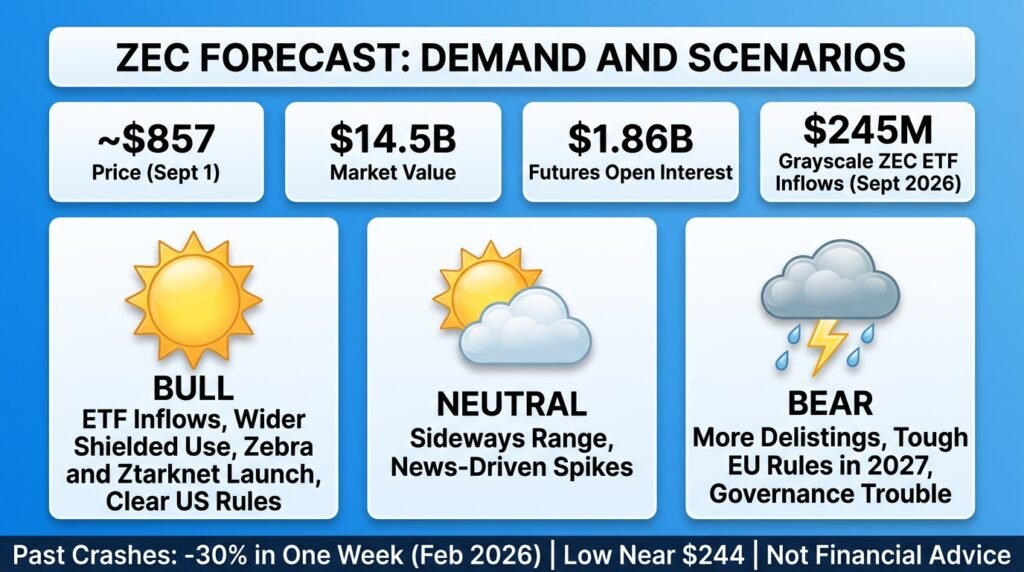
ZEC delivered one of the strongest runs in the market this year, and prices approached $800 in August 2026. One report placed the price near $857 on September 1, with a market value around $14.5 billion. Futures open interest also jumped to about $1.86 billion, which shows heavy trader interest. However, the coin has fallen hard before. It dropped more than 30 percent in a single week in early February and slid toward $244 after leadership changes at Electric Coin Company. Check a live chart before you act, and read the CoinStats analysis for more detail.
- ZEC rallied strongly through 2025 and 2026.
- Futures activity grew fast, which raises volatility.
- Sharp crashes in early 2026 show how quickly sentiment can flip.
Zcash Future Scope: Regulation Around the World
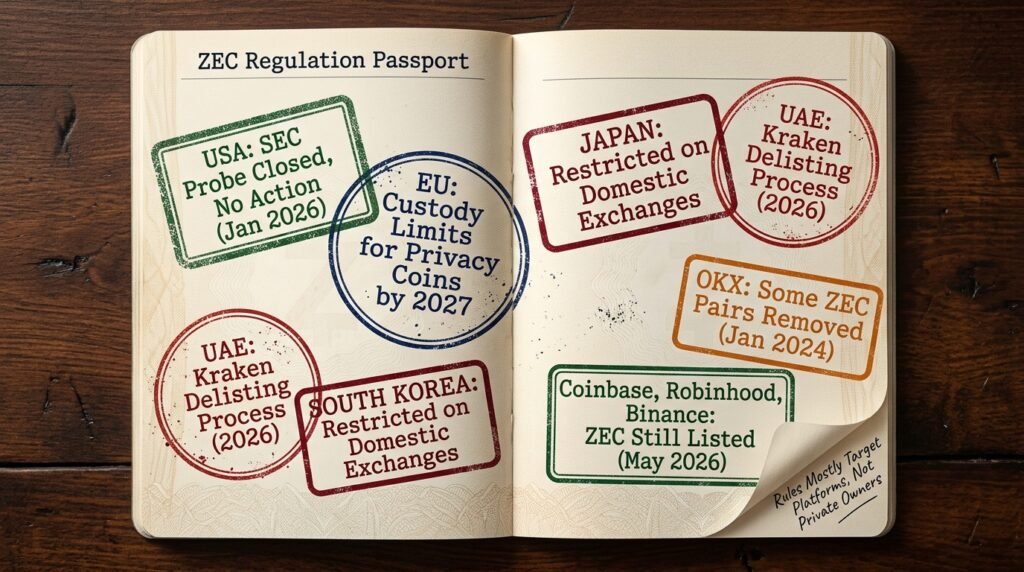
Rules differ widely from country to country. In the United States, the Zcash Foundation said the SEC closed its investigation in January 2026 without taking action, which removed one source of uncertainty. In the European Union, anti-money-laundering rules will phase in bans on custodial support for privacy coins by 2027 for licensed providers. Japan and South Korea already restrict privacy coins on domestic exchanges, and reports say India tightened its stance in 2026. Most countries still allow people to own ZEC, but regulators focus on the platforms that trade it.
- The US investigation ended without enforcement action.
- EU custody limits for privacy coins arrive by 2027.
- Japan and South Korea block privacy coins on regulated exchanges.
Exchange Delistings: Where ZEC Trades and Where It Does Not
Delistings hurt privacy coins more than almost any other risk, because they cut liquidity and on-ramps. OKX removed several ZEC pairs in January 2024. Binance’s Dubai arm said privacy tokens do not meet its local rules, and Kraken announced a 2026 delisting process for ZEC and Monero in the United Arab Emirates. Binance also put ZEC under a community vote in April 2025, then removed the monitoring tag in July 2025. As of May 2026, Coinbase, Robinhood, Kraken outside the UAE, Binance, and OKX still offered ZEC in most regions.
- Delistings often hit specific regions or trading pairs, not the whole coin.
- Each removal can cut liquidity and trigger sharp price drops.
- Check your exchange’s local rules before you buy.
ETF Demand and Institutional Interest
Institutions now have a regulated path into Zcash. Grayscale revived its Zcash trust, and reports say its Zcash ETF attracted about $245 million in September 2026, far ahead of spot Dogecoin and XRP funds in the same period. Whales also joined the trend, and one buyer reportedly collected more than $31 million in ZEC in late September. Fund demand can lift prices and improve legitimacy. However, it also ties the coin to big-money sentiment, and large investors can leave as fast as they arrive. Verify the latest flow data before you rely on these numbers.
- Grayscale gives institutions a regulated way to hold ZEC.
- Large wallets show growing interest from deep-pocket buyers.
- Fund outflows can hit the price just as hard as inflows lift it.
Zcash Future Scope: Technology Upgrades
Developers keep building, and these upgrades support Zcash’s future scope beyond simple payments. The Zebra node, written in Rust, replaces the older zcashd software and aims to improve security and integration. Ztarknet, a layer-2 inspired by Starknet, plans to bring shielded smart contracts to Zcash without changing the main chain’s privacy rules. THORChain also launched native ZEC swaps, which improve cross-chain liquidity. Together, these tools could turn Zcash from a payment coin into a broader privacy platform for finance.
- Zebra modernizes the network software.
- Ztarknet targets private smart contracts and DeFi.
- THORChain swaps widen access without a centralized exchange.
Governance and Network Risks
Zcash faces risks that come from people as much as code. Leadership at Electric Coin Company resigned in early 2026, and the news pushed ZEC sharply lower. Governance fights over funding and direction can distract developers and weaken confidence. Futures markets also look crowded, with one report showing about 69 percent of Binance accounts positioned short, which creates squeeze risk in both directions. Competing privacy technologies could also pull developers and users away if Zcash falls behind. Strong governance matters as much as strong cryptography.
- Leadership changes can shake market confidence.
- Crowded leverage creates sudden liquidation waves.
- Rival privacy projects compete for developers and users.
Can Privacy Coins Survive Regulation?
Evidence suggests they can survive, but with limits. Regulators mostly target exchanges and service providers, not private owners, so coins keep trading through decentralized swaps, peer-to-peer markets, and cross-chain tools. Zcash also offers selective disclosure, which gives it a stronger compliance story than coins with mandatory privacy. Still, delistings shrink mainstream access, and tougher rules can push trading into less visible venues. In my view, Zcash looks better placed than Monero in regulated markets, but that remains an opinion, not a guarantee. This is not financial advice.
- Rules mainly hit platforms, so decentralized access continues.
- Selective disclosure gives Zcash a compliance advantage.
- Reduced access to big exchanges remains a real cost.
Zcash Future Scope: Bull and Bear Scenarios
A bullish path needs more fund inflows, wider shielded usage, successful launches of Zebra and Ztarknet, and steady regulatory clarity in the United States. A neutral path keeps ZEC in a wide range, with regular headlines about delistings and upgrades. A bearish path appears if EU rules bite harder in 2027, more exchanges cut access, governance problems return,n or crowded leverage unwinds. Track these signals together, and follow daily updates on CoinInDesk to stay informed.
- Bull case: ETF flows, strong adoption and clear rules.
- Neutral case: sideways trading with news-driven spikes.
- Bear case: more delistings, strict EU rules, and governance trouble.
FAQs About Zcash Future Scope
What is the future scope of Zcash?
Zcash aims to grow as a privacy platform with optional shielded payments, new smart contract tools, and institutional access. Regulation and delistings remain the biggest hurdles.
Is Zcash legal to use?
Most countries allow people to own and use ZEC. Some regions limit trading on regulated exchanges, so check your local rules.
Why do exchanges delist ZEC?
Exchanges worry that private transactions make anti-money-laundering checks harder, so some platforms remove privacy coins to meet local rules.
Is Zcash better than Monero?
It depends on your goal. Monero offers stronger default privacy, while Zcash offers optional privacy and easier compliance.
Can Zcash survive regulation?
It looks more likely to survive than fully private coins, because it supports transparent transfers and selective disclosure. Still, tougher rules could limit its growth.
