

AVAX tokenomics determines how many Avalanche tokens exist, how stakers earn rewards, and how network fees reduce supply. Avalanche caps AVAX at 720 million tokens, issues new coins as staking rewards, and burns user fees. These three rules work together and shape the long-term value of the token. In this guide, we explain the supply cap, the distribution plan, staking rewards, the fee burn, and the risks you must understand before you buy or stake AVAX.
What Is AVAX Tokenomics?
AVAX tokenomics describes the economic rules that control the Avalanche token, including its supply, rewards, and burns. AVAX does three jobs on the network. Users pay transaction fees with it, validators stake it to secure the chain, and Avalanche Layer-1 networks use it as their basic economic unit. Because the token has several jobs, demand can come from many directions at once. Understanding these rules helps you judge whether the token’s design supports long-term value. You can read the technical details in the Avalanche staking documentation.
The 720 Million AVAX Supply Cap
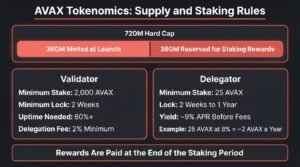
Avalanche follows an idea similar to Bitcoin and sets a hard cap of 720 million AVAX. The network can never create more tokens than this limit. The team minted 360 million AVAX at launch, and it reserved the other 360 million for staking rewards that the protocol releases slowly over decades. This slow release means the circulating supply grows gradually instead of jumping suddenly. For investors, the cap makes AVAX tokenomics more predictable than systems with unlimited supply, because everyone can calculate the maximum number of coins in advance.
How the AVAX Token Distribution Works
Avalanche allocated half of its total supply to staking rewards and used the other half for the community, developers,s and early supporters. This split ties a large share of new supply directly to network security. Validators earn coins only when they help run the chain, so the protocol pays for real work. The release schedule also stretches over many years, which gives the market time to absorb new tokens. Before you invest, check the vesting and unlock schedules of early holders, because large unlocks can still pressure the price. This split plays a central role in AVAX tokenomics, because it links new supply to network security.
AVAX Staking Rewards: Validators and Delegators
AVAX staking rewards come from the reserved pool of 360 million tokens. A validator must stake at least 2,000 AVAX, while a delegator can join with only 25 AVAX. Both groups must lock their coins for at least two weeks, and delegators can stake for up to one year. Validators keep a delegation fee of at least 2 percent from the rewards of their delegators. A validator earns rewards only when it stays online and responsive for more than 80 percent of the staking period, so uptime matters. These staking rules form the backbone of AVAX tokenomics, since they reward the people who secure the chain.
How Much Can You Earn From Staking AVAX?
Staking returns change over time, but reports have placed the yield near 9 percent APR in the past. Validators usually charge fees that cut about 10 percent from that figure, so a delegator might keep around 8 percent. For example, a person who stakes 25 AVAX at 8 percent APR for a year earns about 2 AVAX. The protocol pays rewards at the end of the staking period, so you must restake manually if you want compounding. Reward rates also adjust as supply approaches the cap. Check the live rate on DeFiRate’s AVAX staking page before you decide.
The AVAX Fee Burn Mechanism
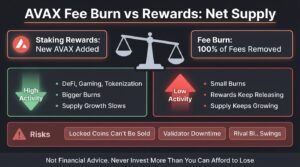
Avalanche burns 100 percent of the transaction fees that users pay. Nobody receives these fees, not even validators, and the tokens leave circulation forever. This design works independently from staking rewards, so the two systems pull supply in opposite directions. Rewards add new coins, while burns remove them. Every transfer, swap, and contract call on the network adds a small burn. When more people use Avalanche, the burn grows, and the token becomes scarcer over time. This feature gives AVAX a direct link to real network activity.
How Fee Burns Shape AVAX Tokenomics
The net supply path of AVAX tokenomics equals the rewards that the protocol releases minus the fees that users burn. High activity from DeFi, gaming, asset tokenization,n and new Layer-1 launches raises the burn and slows supply growth. Low activity does the opposite, because small burns cannot offset the steady reward releases. This means usage matters more than any promise or roadmap. Track fee burn dashboards, staking participation, total value locked, ed and DEX volume to see whether the supply trend moves in your favor. A OneKey research report explains this link in more detail.
Risks and Limits of AVAX Tokenomics
AVAX tokenomics looks strong on paper, but it carries real risks. Burns stay small when network activity drops, so the supply can still grow through rewards. Stakers who lock coins for weeks cannot sell during a sudden price drop. Delegators also depend on validators, and an offline validator can reduce or cancel rewards. Competing blockchains fight for the same users and developers, which can lower demand for AVAX. Price swings can erase staking gains quickly, so size your position carefully and follow market updates on CoinInDesk. This is not financial advice.
FAQs About AVAX Tokenomics
What is the maximum supply of AVAX?
The maximum supply of AVAX is 720 million tokens. The network cannot create more than this limit.
How much AVAX do I need to stake?
Delegators need at least 25 AVAX, while validators need at least 2,000 AVAX. The minimum lock period is two weeks.
Does Avalanche burn AVAX?
Yes. Avalanche burns 100 percent of transaction fees, which permanently removes those tokens from circulation.
Is AVAX inflationary or deflationary?
It depends on activity. Staking rewards add new coins, while fee burns remove them, so heavy network usage pushes supply down.
What are AVAX tokenomics in simple words?
AVAX tokenomics combines a fixed 720 million cap, slow staking reward releases,ses and fee burns to control the token supply.
Final Thoughts on AVAX Tokenomics
AVAX tokenomics gives Avalanche a clear and predictable structure. The hard cap limits the total supply, staking rewards secure the network, and fee burns connect the token to real usage. The model works best when activity grows, so watch burn data and staking participation before you act. Always check live rates and unlock schedules, and never invest more than you can afford to lose. For more daily crypto news and market coverage, keep reading CoinInDesk.
