

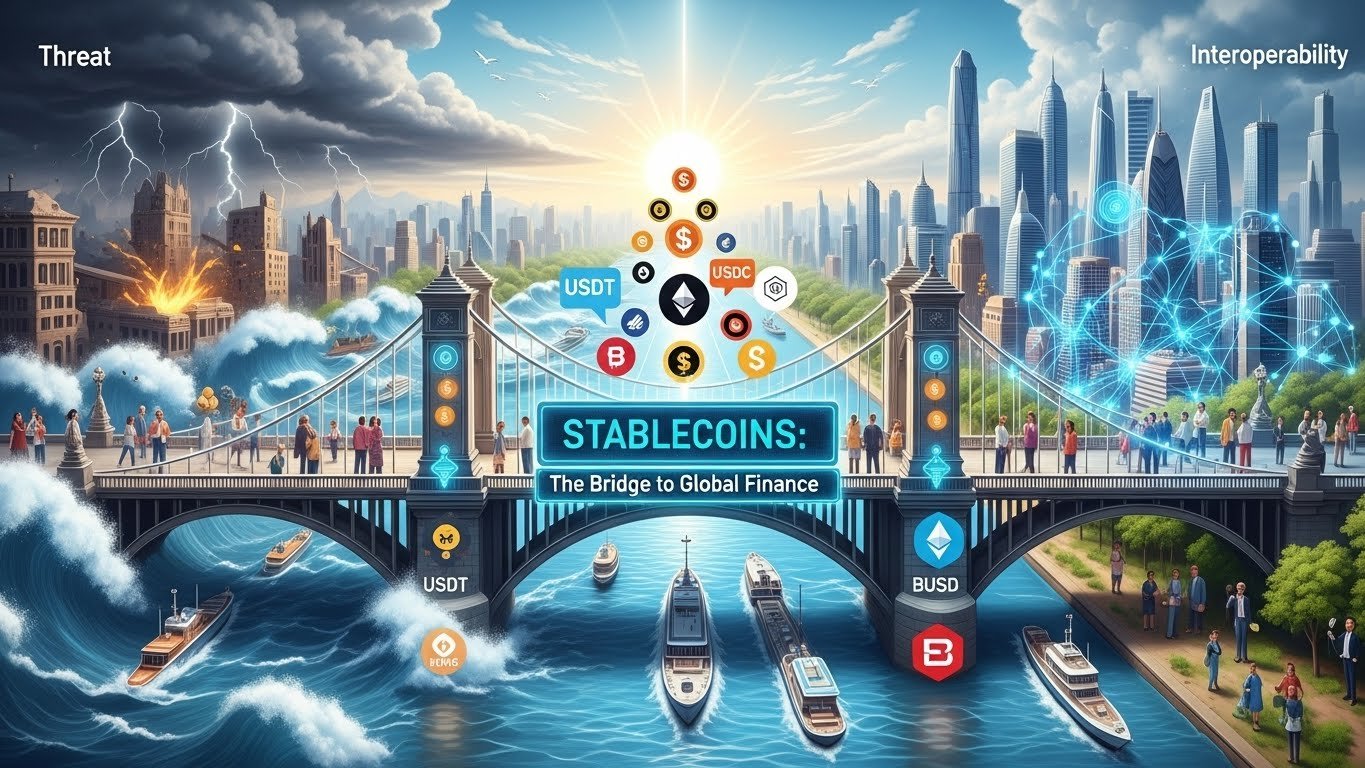
Stablecoins as a bridge not a threat is a narrative that is rapidly gaining traction as global finance enters a new phase of digital transformation. For years, stablecoins were viewed with suspicion by policymakers, banks, and traditional financial institutions, often framed as disruptive instruments that could undermine monetary sovereignty or destabilize financial systems. However, this perception is gradually shifting as the real potential of stablecoins becomes clearer. Rather than replacing existing systems, stablecoins are increasingly understood as connective infrastructure that links fragmented financial networks into a more efficient, inclusive, and interoperable global economy.
At their core, stablecoins are digital assets designed to maintain a stable value, most commonly pegged to fiat currencies. This stability allows them to function as reliable mediums of exchange within blockchain-based systems. In an era defined by cross-border commerce, remote work, and digital services, the ability to move value seamlessly across networks is no longer optional. Interoperability, the capacity of different systems to communicate and transact with one another, is emerging as the defining feature of modern finance.
Stablecoins should be viewed as bridges rather than threats and how interoperability will define the future of global finance. By examining technological, economic, and regulatory dimensions, it becomes clear that stablecoins can enhance existing financial systems while unlocking new opportunities for innovation and inclusion.
Rethinking the Role of Stablecoins in Global Finance
From disruption narrative to infrastructure mindset
Early discussions around stablecoins often focused on disruption. Critics argued that privately issued digital currencies could weaken central bank authority or bypass established banking channels. While these concerns were not unfounded, they overlooked the broader role stablecoins could play as financial infrastructure.
Stablecoins as a bridge not a threat reframes the conversation. Instead of viewing them as competitors to banks or fiat currencies, they can be understood as digital layers that improve settlement speed, reduce costs, and enhance connectivity. This infrastructure mindset aligns stablecoins with the evolution of payment systems rather than their replacement.
Stability as an enabler, not a weapon
The defining feature of stablecoins is price stability. This characteristic makes them uniquely suited for practical financial use. Volatile cryptocurrencies struggle to function as everyday money, but stablecoins provide predictability.
In global finance, predictability enables trust. Businesses, consumers, and institutions can transact without worrying about sudden value fluctuations. This reliability positions stablecoins as neutral tools that facilitate interaction between systems rather than instruments of disruption.
Understanding Interoperability in Financial Systems
What interoperability really means
Interoperability refers to the ability of different platforms, networks, and institutions to exchange information and value seamlessly. In finance, this means enabling payments, settlements, and data flows across borders, currencies, and technologies without friction. Traditional financial systems often lack interoperability. Cross-border transfers involve multiple intermediaries, delays, and high fees. Stablecoins built on blockchain networks offer a programmable alternative that can move value across systems almost instantly.
Why interoperability is now essential
Globalization and digitalization have exposed the limitations of siloed financial systems. Supply chains span continents, freelancers work for international clients, and digital services operate globally. Without interoperable financial infrastructure, these activities face inefficiencies Stablecoins as a bridge not a threat become especially relevant here. By operating on open networks, they can connect disparate systems, enabling smoother global transactions and reducing reliance on outdated processes.
Stablecoins as Connectors Between TradFi and Digital Finance
Bridging traditional banks and blockchain networks
Stablecoins serve as a practical interface between traditional finance and blockchain-based ecosystems. Users can convert fiat into stablecoins, transact on-chain, and return to fiat when needed. This flow creates continuity rather than conflict. Banks and payment providers increasingly recognize this bridging function. Stablecoins can complement existing services by offering faster settlement and lower operational costs while still aligning with familiar currency values.
Enhancing efficiency without replacing institutions
Contrary to fears of disintermediation, stablecoins can enhance the role of financial institutions. Banks can integrate stablecoins into their operations to improve back-office efficiency, cross-border settlements, and liquidity management. Stablecoins do not eliminate intermediaries but transform their function. Institutions shift from gatekeepers to service providers within a more interconnected ecosystem.
Interoperability and Cross-Border Payments
The limitations of current cross-border systems
Cross-border payments remain one of the most inefficient aspects of global finance. Transfers can take days, incur high fees, and require multiple intermediaries. These inefficiencies disproportionately affect small businesses and individuals. Stablecoins address these issues by enabling direct, peer-to-peer transfers on blockchain networks. Transactions settle quickly and transparently, regardless of geographic boundaries.
Stablecoins enabling real-time global value transfer
By operating 24/7 and settling in near real time, stablecoins offer a compelling alternative for international payments. This capability is particularly valuable in regions with limited banking infrastructure. Stablecoins as a bridge not a threat highlights how they can integrate with existing payment systems to enhance speed and accessibility rather than undermine them.
The Role of Interoperability in Financial Inclusion

Expanding access to global finance
Interoperability is not just about efficiency; it is also about inclusion. Millions of people worldwide lack access to traditional banking but have access to mobile devices and the internet. Stablecoins allow these individuals to participate in global commerce, receive payments, and store value digitally. Interoperable systems ensure that these users are not isolated within single platforms but can interact with the broader financial ecosystem.
Empowering emerging markets
In emerging markets, currency volatility and limited financial infrastructure pose significant challenges. Stablecoins pegged to stable currencies can provide a hedge against local instability while enabling participation in global trade. By acting as bridges, stablecoins connect local economies to international markets, supporting economic resilience and growth.
Regulatory Concerns and the Threat Perception
Why regulators initially viewed stablecoins as threats
Regulators have legitimate concerns about stablecoins, including reserve transparency, consumer protection, and systemic risk. Large-scale adoption without oversight could create vulnerabilities. These concerns led to a threat-based narrative, framing stablecoins as risks to monetary control and financial stability. However, this perspective often failed to account for their potential benefits when properly regulated.
Shifting toward a balanced regulatory approach
A more nuanced approach is emerging, recognizing that stablecoins can coexist with traditional systems under appropriate frameworks. Clear rules around reserves, governance, and compliance can mitigate risks while preserving innovation. This shift supports the idea that stablecoins as a bridge not a threat can align with regulatory objectives rather than oppose them.
Interoperability as a Regulatory Opportunity
Harmonizing global standards
Interoperability offers regulators an opportunity to harmonize standards across jurisdictions. Rather than fragmented national approaches, interoperable systems can support consistent compliance mechanisms. Stablecoins operating within standardized frameworks can enhance transparency and traceability, addressing regulatory concerns while enabling cross-border functionality.
Collaboration between public and private sectors
Interoperability encourages collaboration between central banks, regulators, and private innovators. By working together, stakeholders can design systems that balance efficiency, security, and oversight. This collaborative model positions stablecoins as tools for modernization rather than sources of disruption.
Technological Foundations of Interoperable Stablecoins
Blockchain networks and protocol design
The interoperability of stablecoins depends on underlying blockchain architectures. Cross-chain protocols and standardized messaging systems allow assets to move between networks seamlessly. These technological advancements reduce fragmentation within the digital asset ecosystem, reinforcing the bridge narrative.
Programmability and automation
Stablecoins are programmable, enabling automated settlements, compliance checks, and conditional payments. This programmability enhances interoperability by embedding logic directly into transactions. Such features improve efficiency and reduce reliance on manual processes, benefiting both users and institutions.
Economic Implications of an Interoperable Financial Future
Lower costs and increased efficiency
Interoperable systems reduce duplication, intermediaries, and reconciliation costs. Stablecoins contribute to this efficiency by enabling direct value transfer across platforms. Lower costs benefit consumers and businesses, making global finance more accessible and competitive.
Supporting innovation and competition
Interoperability fosters competition by preventing monopolistic control over financial networks. When systems can connect freely, innovation thrives. Stablecoins as a bridge not a threat support this open environment, encouraging new services and business models.
Addressing the Remaining Challenges
Managing systemic risk
As stablecoins grow, their systemic importance increases. Robust risk management, transparency, and oversight are essential to prevent contagion during market stress. Interoperable frameworks can help distribute risk rather than concentrate it within isolated systems.
Ensuring trust and adoption
Trust remains central to adoption. Users must believe that stablecoins are properly backed and governed. Clear standards and open communication are critical. Interoperability enhances trust by allowing users to move assets freely rather than being locked into single platforms.
The Future of Global Finance Defined by Interoperability

Stablecoins as foundational infrastructure
Looking ahead, stablecoins are likely to become foundational components of global financial infrastructure. Their role as connectors will expand as more systems integrate blockchain-based settlement layers. This evolution supports a more resilient, flexible, and inclusive financial system.
Redefining collaboration between systems
Interoperability will redefine how financial systems interact. Rather than competing silos, networks will collaborate through shared standards and protocols. Stablecoins as a bridge not a threat encapsulate this vision of cooperation over competition.
Conclusion
Stablecoins as a bridge not a threat represent a fundamental shift in how digital assets are understood within global finance. Rather than undermining existing systems, stablecoins have the potential to connect them, enhancing efficiency, inclusion, and innovation. Interoperability is the key that unlocks this potential, enabling seamless interaction across borders, platforms, and institutions.
As regulation evolves and technology advances, the focus should move from fear to collaboration. By embracing interoperability, global finance can harness stablecoins as tools for modernization, ensuring that the future financial system is more connected, resilient, and accessible for all.
FAQs
Q: Why are stablecoins considered a bridge rather than a threat to global finance?
Stablecoins are considered a bridge because they connect traditional financial systems with digital networks, improving efficiency and interoperability without replacing existing institutions or currencies.
Q: How does interoperability change the role of stablecoins?
Interoperability allows stablecoins to move seamlessly across platforms and borders, making them useful connectors in global finance rather than isolated digital assets.
Q: Can stablecoins coexist with traditional banks and regulators?
Yes, stablecoins can coexist with banks and regulators when clear frameworks are in place. They can enhance existing systems by offering faster settlement and lower costs.
Q: What role do stablecoins play in cross-border payments?
Stablecoins enable faster and cheaper cross-border payments by reducing intermediaries and settling transactions on blockchain networks in near real time.
Q: Will interoperability define the future of global finance?
Interoperability is likely to define the future of global finance by enabling seamless interaction between diverse systems, and stablecoins are positioned to be central tools in this transformation.
