

Enso + Chainlink CCIP Power has matured from a single-chain experiment into a sprawling multichain ecosystem where users chase liquidity, yield, and new applications across dozens of networks. Yet the experience is still far from seamless. A typical journey might start with assets on one chain, a target protocol on another, and a user stuck in the middle juggling bridges, network switches, repeated approvals, slippage surprises, and an uncomfortable sense that something could go wrong at any step. For years, “cross-chain” often meant one thing: token transfers. Useful, but incomplete. Moving assets is not the same as completing intent.
That gap—between transferring value and completing an outcome—has become one of the biggest bottlenecks in DeFi. Users don’t just want their tokens to arrive somewhere else; they want to swap, deposit, stake, mint, provide liquidity, or enter a strategy without babysitting a dozen steps. This is why the phrase cross-chain execution has become increasingly important. Execution implies completion. It implies that once assets move, something meaningful happens automatically on the destination chain, and the user receives a result that matches their original intent.
Against this backdrop, Enso launching live cross-chain execution with Chainlink CCIP signals a push toward infrastructure that treats interoperability as a programmable workflow rather than a one-off transfer. By combining Enso’s orchestration approach with Chainlink CCIP, the integration aims to deliver a more reliable path from user intent to finalized outcome across networks. It’s also a strategic expansion of DeFi infrastructure: not just a new bridge option, but a building block for safer, more composable, and more product-friendly multichain experiences.
DeFi reality multichain growth created multichain friction
DeFi didn’t become multichain because teams wanted complexity. It happened because different networks offered different advantages: lower fees, faster confirmation times, unique communities, and specialized tooling. Over time, liquidity fragmented across these environments. Protocols expanded to reach users where they were. Users followed incentives and opportunities. The result is today’s world: a rich ecosystem split into silos.
This fragmentation introduces friction in places that matter most. Every extra step reduces conversion and increases abandonment. Every additional approval is another moment of doubt. Even experienced users hesitate when a flow requires bridging, swapping, then interacting with a protocol they’ve never used on a chain they rarely visit. For newcomers, it’s often a hard stop.

A core reason for this friction is that most cross-chain solutions were designed around moving tokens safely, not orchestrating outcomes. When the bridge completes, the user still has work to do. They must switch networks, find the right application, approve tokens again, and execute the next transaction. If anything changes during that time—price movement, liquidity shifts, gas spikes—the final outcome may not match what they expected. The product promise becomes “we can get you there,” rather than “we can finish the job.” That’s exactly the problem live cross-chain execution is meant to solve.
Cross-chain execution: outcomes over transfers
Cross-chain execution means a user can initiate a single intent on one chain and complete a meaningful outcome on another chain without manual intervention between steps. Instead of bridging and then acting, the system bridges and then acts automatically through a programmed sequence. In practical terms, this can include swapping on the destination chain, depositing into a vault, minting a position token, staking into a farm, or providing liquidity to a pool.
This shift sounds subtle, but it changes everything. When outcomes are the focus, product design can become simpler. A wallet can offer “one click deposit” across chains. An aggregator can route to a target position rather than just the cheapest swap. A protocol can onboard liquidity from other chains without building and maintaining a complicated integration stack.
To make this work, an execution layer must coordinate three things reliably: asset movement, message delivery, and deterministic post-transfer actions. That coordination is where infrastructure choices matter—and where Chainlink CCIP becomes particularly relevant.
Enso’s role: an execution layer for composable DeFi actions
Enso is building infrastructure that helps developers compose onchain actions into coherent workflows. The idea is to standardize the way applications execute sequences like “swap then deposit” or “bridge then mint.” Instead of hand-crafting integrations for every protocol and chain combination, developers can structure interactions as composable actions and bundles, reducing overhead and making it easier to ship complex experiences.
In a multichain world, that orchestration capability becomes far more valuable. A single product might need to support users from many networks and route them to strategies on other networks. Without a unifying execution layer, teams end up stitching together separate routers, bridge APIs, transaction builders, and fallback mechanisms—each with its own quirks and risks. Enso’s move into live cross-chain execution reflects a clear thesis: the future of DeFi UX depends on abstracting away chain boundaries. Users should express intent, and the system should do the rest.
From single-chain bundles to cross-chain workflows
Single-chain execution is already complex because it involves approvals, routing, gas estimation, and multi-step transactions. Cross-chain adds more variables: finality differences, message timing, bridge conditions, and destination-chain states. Enso’s approach treats these challenges as orchestration problems that can be standardized.
When Enso launches live cross-chain execution with Chainlink CCIP, it strengthens this orchestration stack by adding a cross-chain pathway that can support more robust execution logic. That matters especially for flows where reliability and security are more important than raw speed.
Why Chainlink CCIP matters: programmable interoperability with security focus
Not all interoperability solutions are optimized for the same objective. Some prioritize speed. Some prioritize low costs. Some prioritize broad chain coverage. Chainlink CCIP is often associated with programmable interoperability, combining token transfers with cross-chain messaging in a way that supports instruction delivery and destination execution.
In the context of live cross-chain execution, this programmability is crucial. Execution requires more than moving assets. It requires passing data, parameters, and instructions that define what should happen next. A cross-chain message must arrive intact and be processed in a controlled manner. The destination chain needs enough information to carry out the intended actions safely.
Finality-aware behavior and execution confidence
Cross-chain workflows can fail in frustrating ways when they run on uncertain state. If a source chain transaction can be reorganized or reversed, executing destination-chain actions prematurely can create inconsistencies. A finality-aware approach—waiting until the source chain state is sufficiently settled—can help reduce this class of problems.
This is one reason CCIP is often considered a good fit for execution-heavy flows. While finality-aware behavior may increase wait times on some networks, it can improve confidence that the system is executing on irreversible state. For higher-value or more complex strategies, that tradeoff can be worthwhile.
Payload capacity: why “more data” enables more products
Cross-chain execution frequently needs richer data than a basic bridge transfer. Complex workflows may involve multiple actions, multiple destinations, specialized parameters, and safeguards. If the cross-chain pathway limits how much information can be carried, developers must simplify product features, reduce automation, or add manual steps. By aligning with Chainlink CCIP, Enso can support more expressive execution instructions, which in turn supports richer DeFi experiences. This is one of the hidden ways infrastructure expands what builders can realistically ship.
Enso launches live cross-chain execution with Chainlink CCIP: what changes now
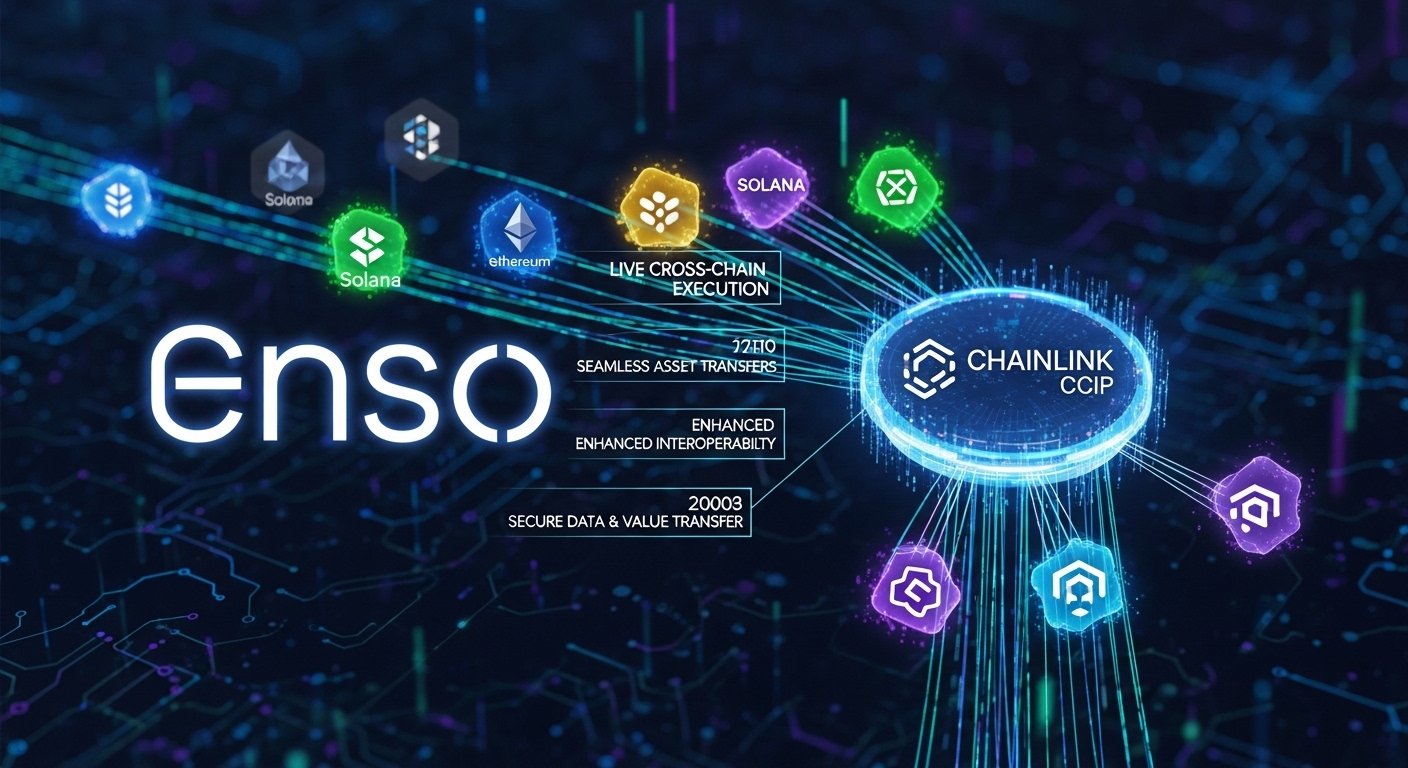
When Enso launches live cross-chain execution with Chainlink CCIP, the practical impact is that builders can design cross-chain user journeys that complete more reliably and support more sophisticated automation. Instead of forcing users to bridge and then continue manually, applications can coordinate destination-chain actions through a programmed callback sequence. This matters for two big reasons. First, it improves user experience by reducing steps and confusion. Second, it reduces integration complexity by letting teams rely on standardized execution primitives rather than building custom glue for every chain combination.
Cross-chain swaps that end in a destination position
A common DeFi intent is not “hold tokens on chain B,” but “enter a position on chain B.” That might be a vault share, a staked token, or a liquidity position. Live cross-chain execution makes it feasible to treat that as a single journey. Assets can be routed across chains and then automatically swapped or deposited into the target protocol. The result is a more product-native experience. The user sees an outcome. The infrastructure handles the mechanics.
Cross-chain deposits for yield and strategy access
Yield opportunities are often chain-specific. Some networks host unique lending markets, structured vaults, or incentive-heavy farms. Users holding assets elsewhere may want exposure without manual cross-chain effort. Live cross-chain execution enables “deposit from anywhere” experiences, where the user funds a strategy on a target chain without stepping through multiple interfaces. This is also a powerful growth lever for protocols. It reduces the friction of onboarding capital from other ecosystems and supports more universal access to DeFi products.
Cross-chain liquidity provisioning and market depth
Liquidity fragmentation is a persistent issue in multichain DeFi. Even strong protocols can suffer from thin liquidity on a new network. Cross-chain execution can help by enabling automated liquidity provisioning flows. A user could supply capital from a source chain and end with a liquidity position on a destination chain in one coordinated sequence. Over time, these flows can contribute to deeper markets and more stable trading environments across networks, which is a direct form of DeFi infrastructure expansion.
How this expands DeFi infrastructure: composability across chain boundaries
DeFi infrastructure is most valuable when it increases what builders can create while reducing the complexity of creating it. Enso’s live cross-chain execution with Chainlink CCIP expands infrastructure in three practical ways: composability, reliability, and product design freedom.
Composability: rebuilding “money legos” across networks
Early DeFi’s breakthrough was composability on a single chain. Protocols could be combined into new products without needing special partnerships. Multichain growth weakened that composability because assets and logic were separated. Cross-chain execution restores some of that power by allowing workflows that span networks as if they were a single programmable environment. This is where bold, outcome-driven design becomes possible. Builders can create multichain strategies that feel unified rather than stitched together.
Reliability: fewer partial journeys and fewer dead ends
One of the worst multichain experiences is a partial journey: the bridge completes, but the destination action fails or never occurs. Users end up with tokens in an unfamiliar chain, unsure what to do next, or forced to pay additional gas to finish the process. Live cross-chain execution reduces this pattern by coordinating the destination actions as part of the same intended workflow. No infrastructure can eliminate every failure mode, but better orchestration can reduce the frequency of confusing dead ends and improve user trust over time.
Product freedom: building for outcomes without sacrificing safeguards
When execution is programmable, teams can incorporate safeguards: slippage checks, minimum received values, validation steps, and controlled callbacks. That makes it easier to build consumer-grade DeFi products without stripping away necessary protections.
Key design considerations for builders adopting live cross-chain execution
To use cross-chain execution well, builders must design with the realities of multichain systems in mind. The goal is not to hide complexity by ignoring it, but to hide complexity by handling it.
Timing and user expectations
Finality differs by chain. Congestion differs by chain. Cross-chain messages introduce additional timing variance. A good product sets expectations clearly and designs progress feedback that feels trustworthy. Users are surprisingly patient when they understand what’s happening and why.
Slippage and price movement across chains
The longer the cross-chain journey, the more chance price conditions change. For execution flows that include destination swaps, it’s important to incorporate slippage protections and minimum output checks. If the market moves too much, the system should fail safely rather than completing a bad trade.
Graceful handling of failures
Even with strong infrastructure, failures can happen. Bridges can face congestion. Destination chain gas can spike. Liquidity can change. A resilient execution experience includes sensible fallback logic and user-friendly recovery paths. When something doesn’t complete, the user should still be able to understand what happened and what they can do next. These considerations aren’t drawbacks; they’re realities that separate experimental cross-chain experiences from production-grade DeFi infrastructure.
What this means for the broader DeFi ecosystem
The long-term impact of Enso launching live cross-chain execution with Chainlink CCIP goes beyond one integration. It signals a trend: DeFi is shifting from chain-specific apps to intent-based products. Users care less about where execution happens and more about whether execution completes safely and predictably.
As this approach spreads, we can expect more applications to behave like high-level routers of outcomes. Wallets may become execution hubs. Aggregators may optimize for final positions rather than intermediate assets. Protocols may compete more on product clarity and reliability than on which chain they launched first. In that world, infrastructure that reduces multichain friction becomes a competitive advantage, not just a technical feature.
Conclusion
Enso launches live cross-chain execution with Chainlink CCIP at a time when DeFi’s biggest challenge is no longer innovation in primitives—it’s innovation in usability and reliability across a fragmented multichain landscape. By pairing Enso’s orchestration layer with Chainlink CCIP and its programmable interoperability, the integration supports a future where cross-chain journeys can be designed as complete outcomes rather than incomplete transfers.
This is a meaningful expansion of DeFi infrastructure because it increases composability across chain boundaries, improves the chances that users reach their intended destination, and gives builders more freedom to create sophisticated multichain products without drowning in integration complexity. As multichain becomes the default reality, execution—not just bridging—will define the next phase of DeFi growth.
FAQs
Q: What is the difference between bridging and cross-chain execution?
Bridging typically moves tokens from one chain to another and stops there. Cross-chain execution continues after the transfer by running programmed actions on the destination chain, aiming to complete an outcome like a swap, deposit, or stake.
Q: Why is Chainlink CCIP important for live cross-chain execution?
Chainlink CCIP is designed for programmable interoperability, combining token transfer and messaging so destination-chain actions can be triggered with instructions, which is essential for execution-based workflows.
Q: Will live cross-chain execution always be fast?
Speed depends on network conditions and finality behavior. Some cross-chain routes prioritize reliability and settlement confidence, which can add time. The benefit is often greater predictability and safer execution for complex workflows.
Q: Which DeFi use cases benefit most from cross-chain execution?
Cross-chain deposits into vaults, automated entry into yield strategies, cross-chain swaps that end in a destination position, and cross-chain liquidity provisioning are all strong fits because they require more than simple token movement.
Q: How does this expand DeFi infrastructure for builders?
It reduces integration overhead, enables more composable multichain workflows, supports more reliable outcome-driven UX, and makes it easier to build omnichain DeFi products that hide chain complexity while preserving safeguards.
